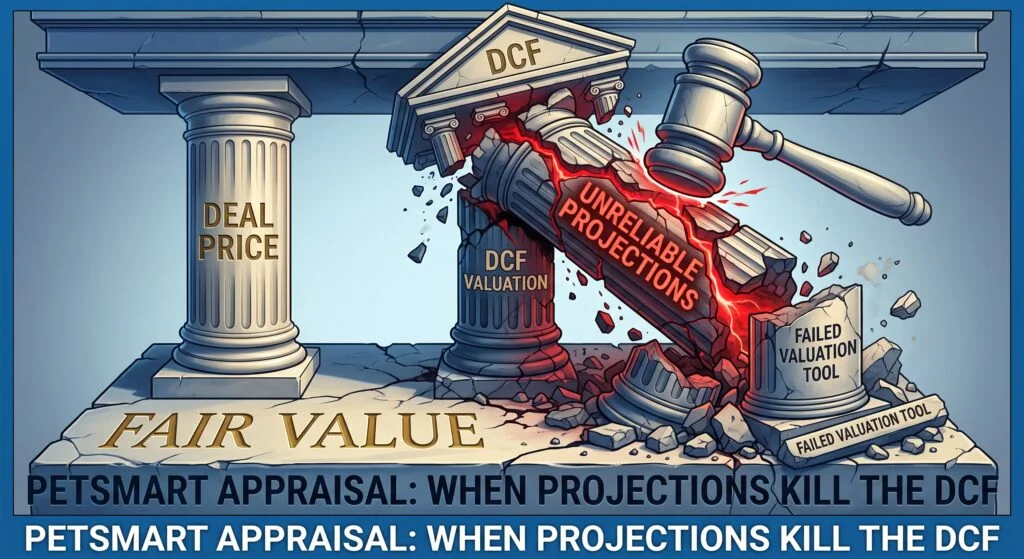

In most Delaware appraisal cases, the court picks a side. It adopts the deal price (DFC Global, Dell, Stillwater), or it adopts one expert’s DCF (In Re Cellular), or it rejects both experts and builds its own model (Blue Blade v. Norcraft). In Ramcell, Inc. v. Alltel Corp., C.A. No. 2019-0601-PAF (Del. Ch. July 1, 2022), the court did something different: it blended the two experts’ models, weighting and averaging the inputs rather than choosing between them. The petitioner’s expert valued Jackson Cellular at $36,016 per share. The respondent’s expert came in at $5,690. The spread was more than sixfold. The court’s blended result: $11,464 per share — nearly four times the $2,963 merger consideration.
That outcome sounds like a win for the petitioner, and it was. But the way the court arrived there contains a warning that matters more than the number: the petitioner’s projections were discounted to 30% weight specifically because they were created after the merger, for litigation purposes, rather than in the ordinary course of business. The court trusted historical data at 70% and litigation-built projections at 30%. If the petitioner’s expert had been working from ordinary-course forecasts, the outcome might have been dramatically different.
A Short-Form Merger with No Deal Price to Defer To
Jackson Cellular Telephone Co. was a wireless communications company serving the Jackson, Mississippi metropolitan area. In the 1980s, the FCC awarded Jackson the rights to construct a cellular network in the Jackson MSA through a lottery. By 2009, Verizon had acquired Jackson’s majority owner, Alltel, and integrated Jackson’s operations with its own. Jackson operated as a subsidiary, with Verizon managing all operations, marketing, and network services. Jackson had no independent management team producing its own financial forecasts.
In April 2019, Alltel — holding 90% of Jackson’s common stock — effected a short-form merger under Delaware §253. Each share of Jackson stock was converted to the right to receive $2,963. No board vote, no shareholder vote, no sale process, no market check. That’s the nature of a short-form merger: the controlling shareholder doesn’t need anyone’s permission. The minority’s remedy is statutory appraisal.
Ramcell, holding approximately 155 shares (less than 1% of Jackson’s stock), filed for appraisal. Because there was no sale process, no deal price to defer to, and no public market for Jackson’s shares, both parties agreed that a DCF was the only appropriate valuation methodology. The entire case turned on whose DCF inputs the court would credit.
A Sixfold Spread Between the Experts
The petitioner’s expert, J. Armand Musey of Summit Ridge Group, valued Jackson at up to $36,016 per share. The respondent’s expert, Joseph Thompson of the Griffing Group, valued Jackson at $5,690.92. The spread — more than six to one on the same company, using the same methodology, as of the same date — reflected fundamentally different assumptions about Jackson’s future cash flows, the appropriate discount rate, and the terminal value.
Practitioners familiar with Delaware appraisal litigation will recognize Musey’s name: he was the petitioners’ expert in In Re Cellular Telephone Partnership Litigation, where Vice Chancellor Laster adopted his DCF as the basis for a $714 million fair value determination. In Cellular, Musey’s projections reflected the growth trajectory AT&T’s own executives had been describing to investors. In Ramcell, the dynamic was different: Jackson had no independent management producing forecasts, and Musey’s projections were created after the merger specifically for the litigation. That distinction drove the court’s decision to weight his projections at only 30%.
How the Court Blended the Models
Rather than adopting one expert’s model or building its own from scratch, the court evaluated each DCF component independently and selected or blended the most credible inputs:
Projections (70/30 blend). The court found that neither set of projections was reliable standing alone. Thompson’s projections for the respondent were grounded in Jackson’s historical financial data but were criticized for being overly conservative. Musey’s projections for the petitioner were based on projected subscriber numbers and growth assumptions, but were created post-merger for litigation purposes — a fact the court weighed heavily against their credibility. The court assigned 70% weight to Thompson’s historically grounded estimates and 30% to Musey’s forward-looking projections. The rationale: historical data is empirically verifiable; litigation-built projections are inherently advocacy-influenced.
Discount rate (blended at 7.847%). Musey assumed Jackson’s discount rate was identical to Verizon’s at 6.8% — an assumption the court found “simplistic,” since Jackson was a small subsidiary operating in a single MSA, not a $200 billion national wireless carrier. Thompson proposed 12.9%, which the court found “suspect” and unsupported by his data selection. Neither rate was credible. The court blended them at 7.847%, drawing on the defensible elements of each expert’s build-up.
Terminal growth rate (2.2%, adopting Ramcell’s approach with adjustments). The court favored Musey’s approach to terminal value — industry growth forecasts with discounts for Jackson MSA-specific characteristics — but found inaccuracies in his data and adjusted the rate downward to 2.2%. Thompson’s terminal value implied a return on invested capital of 193–227%, which the court found implausible in a competitive industry. The court adopted what valuation practitioners call the “convergence approach,” constraining the long-run return on capital to a rate closer to the cost of capital.
The result: $11,464.57 per share, for a total judgment of $1,781,948.74. Nearly four times the merger consideration. Alltel was ordered to bear all costs and fees.
The Litigation-Built Projections Problem
This is the section that distinguishes Ramcell from Cellular and from the deal-price-deference cases. The reason Musey’s projections were discounted to 30% — despite his credentials and his track record in Cellular — is that they were created after the merger for the specific purpose of litigation.
Jackson had no independent management team producing ordinary-course financial forecasts. The company’s operations were fully integrated with Verizon. There were no board presentations, no annual budgets, no long-range plans that pre-dated the merger and could serve as the basis for a DCF. Musey had to build his projections from scratch using subscriber data, industry benchmarks, and assumptions about how Jackson would have performed as a standalone entity — assumptions that were, by definition, untestable.
Compare that to In Re Cellular, where Musey’s projections were anchored in AT&T’s own internal documents. AT&T’s executives had been telling investors about the data revenue growth opportunity. The projections reflected what the company itself believed about its future. In Ramcell, there was no such anchor. The projections reflected what the petitioner’s expert believed, constructed after the fact.
The court didn’t reject Musey’s projections entirely — it gave them 30% weight. But the implicit message is clear: projections built for litigation start at a credibility deficit. They may be technically sound. They may reflect reasonable assumptions. But they lack the institutional imprimatur that comes from being the numbers the company itself was using to run the business. And that deficit translates directly into reduced weight.
For practitioners, this connects to the projection governance lesson from PetSmart: the best time to build the projections that will support a DCF in litigation is before anyone knows there will be litigation. Ordinary-course forecasts, prepared by management in the regular course of business, carry more weight than any expert’s post-hoc reconstruction — no matter how credentialed the expert.
When Both Models Are Flawed: A Preparation Checklist
Ramcell shows that when neither expert produces a fully credible DCF, the court doesn’t default to the deal price or throw up its hands. It cherry-picks. Each input in your model will be evaluated independently, and the court will blend inputs from both sides based on which is more defensible. For litigation counsel preparing an expert for a short-form merger appraisal:
Are the projections ordinary-course or litigation-built? If the company produced financial forecasts before the merger, use them. If it didn’t, document the basis for every assumption with verifiable data — industry benchmarks, historical performance, comparable company metrics — and concede explicitly that the projections are reconstructions. A court that sees the expert acknowledging the limitation will treat the projections more favorably than one that catches the expert trying to pass litigation-built numbers off as management forecasts.
Can you defend each DCF component independently? The court in Ramcell didn’t evaluate the models as integrated wholes. It evaluated projections, discount rate, and terminal value separately, selecting the most defensible version of each. Your expert’s model needs to survive component-by-component scrutiny, not just produce a defensible bottom-line number.
Does the discount rate reflect the subject company or a convenient proxy? Musey’s use of Verizon’s discount rate for a single-MSA subsidiary was “simplistic.” Thompson’s 12.9% was unsupported. Neither survived. The discount rate must reflect the subject company’s specific risk profile — size, geographic concentration, customer concentration, competitive position — not the parent company’s cost of capital or an inflated rate designed to produce a desired answer.
Does the terminal value imply a plausible return on capital? The court flagged Thompson’s terminal value for implying a 193–227% return on invested capital — an obvious red flag. Run the implied ROIC on your expert’s terminal value before the other side does. If it implies returns that couldn’t survive in a competitive market, the terminal value is advocacy, not analysis.
When You Don’t Need to Fight Over Every Input
Not every short-form merger appraisal requires a full-scale DCF battle. If the merger consideration was based on an independent appraisal that used defensible methodology and the minority shareholder’s alternative valuation depends on litigation-built projections with no ordinary-course anchor, the cost of litigation may exceed the likely incremental recovery. Ramcell won a judgment of $1.78 million on 155 shares — but the litigation took three years and a two-day trial. The economics depend heavily on the number of shares at stake and the spread between the merger price and a realistic fair value estimate.
Before filing, run the threshold analysis: is there ordinary-course financial data that supports a value materially above the merger price? If not, your expert will be building projections from scratch, and those projections will arrive in court at a credibility deficit. Ramcell shows that even discounted projections can produce a result well above the merger price — but only when the respondent’s model has its own serious flaws. If the respondent’s expert produces a credible DCF grounded in historical data, litigation-built projections at 30% weight may not move the needle enough to justify the cost.
The Practical Takeaway
Ramcell occupies a distinctive niche in Delaware appraisal law: the short-form merger with no deal price, no sale process, and no ordinary-course projections. When both experts’ models have serious flaws, the court blends rather than chooses — evaluating each input independently and weighting them by credibility. The petitioner’s expert, despite his credentials and his track record in Cellular, had his projections weighted at only 30% because they were litigation-built. The respondent’s expert had his discount rate blended down because it was unsupported. The lesson for both sides: in a blended-model case, every input is a separate front. The expert who can defend each component independently — projections, discount rate, terminal value — with verifiable data and acknowledged limitations is the expert who controls more of the final number.
If you’re evaluating an appraisal claim in a short-form merger and need to determine whether the available financial data can support a DCF that will carry weight in court, happy to talk through the analysis. The projection credibility question often determines the outcome before the model is built.