 Written by Chris Walton, JD
Where deals get made, where they get broken, and what the “standard of value” actually means
An M&A transaction is a legal document wrapped around a valuation. The legal architecture is real and matters, but it is the valuation underneath that determines whether the deal closes, whether it survives post-closing, and whether the parties end up in court three years later. Counsel and management who understand the valuation layer make better deals; those who don’t tend to find out at closing what they should have understood at the term sheet.
This guide maps the valuation issues that recur across the M&A deal lifecycle — pre-signing, at signing, post-closing, and in dispute. It is written for two audiences that need the same information for different reasons: M&A counsel who need to spot valuation issues before they become legal issues, and founders, CEOs, and CFOs on either side of a deal who need to understand what their financial advisors and counsel are actually pricing in.
Experienced PE deal teams with in-house valuation specialists. Senior M&A partners who already speak fluent ASC 805 and Delaware appraisal doctrine. Corporate development executives who have run a dozen processes in a row. If you have institutional muscle memory on the valuation/legal interplay, this guide will tell you nothing new. It is for deal teams that touch M&A periodically — corporate counsel managing a one-off transaction, T&E attorneys advising founder-clients on a liquidity event, founders running a sale process for the first time, CFOs onboarding a new acquisition — and need a working map of where valuation actually sits in the deal.
The most common source of confusion in M&A valuation is treating “value” as if it were a single number. It isn’t. A target company has at least four distinct values that may apply at different points in the same deal.
Fair market value, the IRS standard, is the price at which property would change hands between a willing buyer and a willing seller, neither under compulsion and both with reasonable knowledge of the relevant facts. It is the gold standard for tax purposes — gift, estate, 409A, charitable contribution — and it is rarely the actual deal price in a synergistic M&A transaction.
Fair value for financial reporting, under ASC 820 and applied through ASC 805 for purchase accounting, is similar in concept but measured from the perspective of market participants. It is the standard that governs purchase price allocation after closing.
Fair value for appraisal purposes, under Delaware General Corporation Law §262, is something else entirely. Delaware fair value is the going-concern value of the target as a standalone enterprise, excluding any value arising from the merger itself — including synergies. It is the standard that applies when dissenting stockholders perfect appraisal rights, and the Delaware Supreme Court’s decisions in DFC Global Corp. v. Muirfield Value Partners, L.P., 172 A.3d 346 (Del. 2017), and Verition Partners Master Fund Ltd. v. Aruba Networks, Inc., 210 A.3d 128 (Del. 2019), have shaped how Chancery applies it in cash-out merger cases.
Investment value, sometimes called strategic value, is the value of the target to a specific buyer, including synergies, financing structure, and tax attributes available only to that buyer. It is the standard that drives bid economics in a synergistic acquisition and produces the highest number on the page.
Same target, four numbers — often materially different. The question for counsel and operators is which standard applies at each phase of the deal, because the methodology that produces one number is not the methodology that produces another.
Most M&A deals are economically priced before counsel sees the term sheet. The bid range, the synergy assumptions, the working capital target, and the treatment of debt-like items are set during financial diligence. By the time the legal team is drafting the purchase agreement, the major economic terms are mostly fixed.
Three pre-signing valuation issues account for an outsized share of post-closing disputes. First, synergy treatment: who gets credit for synergies in the bid economics? Buyers want to keep them; sellers want them shared. The answer is partly strategic and partly methodological — synergies belong in investment value, not in fair market value or appraisal fair value. Confusing the standards confuses the bid. Second, working capital target: the net working capital peg should reflect the target’s normalized operating capital requirement, not a snapshot at a single date. Disputes arise when the peg is set against an unrepresentative balance sheet — a quarter-end with elevated receivables, or a period before a seasonal inventory build. Third, debt-like items: deferred revenue, accrued PTO, customer deposits, capital lease obligations, unfunded pension liabilities, and contingent earnout obligations from prior acquisitions are all common candidates for “indebtedness” under the purchase agreement, and all are contested at closing if not specified in advance.
Since Smith v. Van Gorkom, 488 A.2d 858 (Del. 1985), boards in significant M&A transactions have understood that obtaining a fairness opinion is part of demonstrating informed business judgment. Revlon, Inc. v. MacAndrews & Forbes Holdings, Inc., 506 A.2d 173 (Del. 1986), and its progeny extended this to change-of-control transactions, where the board’s fiduciary duty shifts to maximizing immediate stockholder value.
A fairness opinion does one thing: it opines that the consideration to be received by stockholders is fair, from a financial point of view, as of the date of the opinion. It does not opine that the price is the highest available, that the deal is strategically wise, that synergies will be realized, or that the post-closing combined entity will perform well. Counsel who treat the fairness opinion as a generalized blessing of the deal misread it; counsel who treat it as a one-time deliverable that does not need to be refreshed when material facts change misread it differently.
Public-company deals require disclosure of the fairness opinion in the proxy statement, including the financial analyses underlying it. After Corwin v. KKR Financial Holdings, LLC, 125 A.3d 304 (Del. 2015), a fully informed, uncoerced majority vote of disinterested stockholders cleanses the deal of fiduciary-duty challenges outside the controlling-stockholder context, leaving only a claim for waste. But the cleansing effect depends on the vote being fully informed — disclosure litigation focused on the financial-analysis disclosures in the proxy statement remains a live risk when material analyses are omitted or misleadingly described.
Where the deal is structured as a leveraged buyout, a leveraged recapitalization, or a dividend recap, a solvency opinion serves a different purpose from a fairness opinion. It opines on three tests, taken from the federal fraudulent transfer statute (11 U.S.C. §548) and the Uniform Voidable Transactions Act: balance sheet solvency (assets exceed liabilities at fair valuation), cash flow solvency (the company can pay debts as they come due), and reasonable capital (the company has adequate capital for the business it will operate post-transaction).
A solvency opinion does not eliminate fraudulent transfer risk, but it provides directors and lenders with substantial evidence of good-faith analysis if the transaction is later attacked in bankruptcy. It is now standard in most leveraged transactions of meaningful size and increasingly common in dividend recaps even outside the PE context. Counsel advising directors on leveraged deals should treat the question of whether to obtain one as a default-on rather than default-off decision.
After closing, the buyer must allocate the purchase price across the assets acquired under ASC 805. Intangible assets are identified and valued separately from goodwill: customer relationships (typically valued under the multi-period excess earnings method), developed technology (relief-from-royalty), trade names (relief-from-royalty), non-compete agreements (with/without method), and any in-process research and development.
Three points about ASC 805 are worth flagging. First, the work is auditor-scrutinized, and a defensible PPA requires documented methodology, not just a result; valuation firms producing PPAs that read as conclusion-driven rather than methodology-driven create audit risk for the buyer. Second, the tax allocation under IRC §1060 (for asset deals and §338(h)(10) deemed-asset deals) follows a different framework and may produce different numbers for tax purposes than for financial reporting. Third, contingent consideration — earnouts, holdbacks tied to milestones, indemnification escrows — must be recorded at fair value at closing and remeasured thereafter, with changes flowing through earnings.
Earnout valuation in particular has become an area of recurring audit and litigation risk. The fair value of an earnout at closing is rarely just the expected payout; it requires a probability-weighted analysis under the probability-weighted expected return method or, where the earnout has option-like features, an option pricing model such as Black-Scholes or Monte Carlo simulation. Earnouts drafted without attention to how they will be valued tend to produce surprise hits to earnings in subsequent periods — a result that catches CFOs unprepared and frustrates audit committees.
When M&A deals end up in court, valuation is usually the issue, not the legal terms. Four dispute categories recur.
Post-closing purchase price adjustments. Disagreements over working capital, debt, or cash determinations at closing. Almost always driven by ambiguity in the purchase agreement’s definitions, resolved through the dispute mechanism (typically a neutral accountant or arbitrator).
Earnout disputes. Claims that the buyer manipulated post-closing operations to avoid earnout payments, or that the milestones were unfairly measured. Largely a drafting problem at the deal stage, but increasingly a valuation problem at the resolution stage when the question becomes what the earnout would have paid out under proper performance.
Indemnification claims. Usually framed as breaches of representations and warranties, but turning on the valuation impact of the alleged breach. Damages are typically diminution in value, which requires re-doing the valuation as if the misrepresented fact had been known at signing.
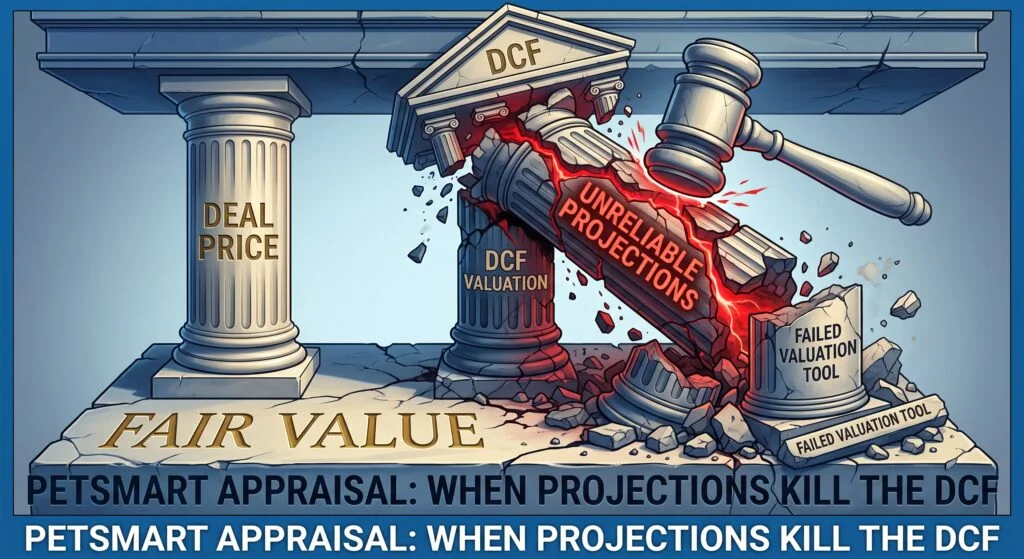
Appraisal rights. Dissenting stockholders in a cash-out merger seeking judicial determination of fair value under DGCL §262. Since DFC Global and Aruba, Delaware courts have generally been more willing to defer to deal price (or deal price less synergies) as evidence of fair value where the sale process was clean, but appraisal remains a live risk in any cash-out transaction involving an interested process, a constrained sale, or a controlling stockholder.
In practice, a recurring set of valuation failures shows up across M&A deals — patterns that experienced deal teams learn to avoid and that less experienced teams discover the hard way.
Wrong standard of value. The bid is built using investment value (synergy-inclusive); the gift tax disclosure for the founder’s rollover equity uses investment value rather than fair market value; the post-closing PPA imports deal-price multiples into ASC 805 fair value without adjustment. Each of these is a distinct standard with its own methodology. Conflating them produces inconsistent numbers across documents and audit findings post-closing.
Synergies assigned to the wrong party. The buyer’s model captures 100% of expected synergies in the DCF used to support the bid; the seller’s banker assumes a 50/50 split when calibrating the ask. The deal closes at a price reflecting partial synergy capture — but if the parties never agreed on the split, the post-closing earnout disputes follow naturally.
Stale fairness opinion. The opinion was issued at signing; material developments between signing and closing changed the analysis; the board did not refresh the opinion before closing. This is the post-Van Gorkom risk that boards forget — the opinion supports informed business judgment as of its date, not in perpetuity.
Conclusion-driven PPA. The valuation firm produces a purchase price allocation that reverse-engineers from a target goodwill number rather than building from defensible intangible asset valuations. The auditor’s question — show me the method — gets a circular answer. The buyer absorbs the audit risk.
Earnout without a valuation in mind. The earnout is drafted by deal counsel against revenue or EBITDA targets that look reasonable but were never modeled probabilistically. At closing, the valuation firm has to fit a probabilistic model to a definition that wasn’t designed for one. The resulting fair value either reflects the awkward fit or sits on a footnote that audit will challenge.
Debt-like definitions left vague. The purchase agreement lists categories but leaves the line items unspecified. Closing turns into a renegotiation of what counts as debt. The dispute mechanism — typically an accountant arbitrator — gets handed a fight that should have been resolved at signing.
Eton Venture Services provides valuation work across the M&A deal lifecycle — fairness opinions, solvency opinions, ASC 805 purchase price allocation, contingent consideration and earnout valuation, and dispute valuation. Each engagement is built from the regulatory and case-law text outward, designed to satisfy auditor scrutiny, board fiduciary requirements, and judicial review.
Chris Walton, JD, is the President and CEO of Eton Venture Services, Ltd. Co. He can be reached at cwalton@etonvs.com.
Schedule an initial call today to discuss your valuation needs.