
Hi, I’m Chris Walton, author of this guide and CEO of Eton Venture Services.
I’ve spent much of my career working as a corporate transactional lawyer at Gunderson Dettmer, becoming an expert in tax law & venture financing. Since starting Eton, I’ve completed thousands of business valuations for companies of all sizes.

Read my full bio here.
Eqvista has become a common choice for startups that want cap table software and a 409A valuation in one place.
On the surface, that seems efficient. Your equity data lives in one system, and the platform uses it to produce a fair market value that you can use to price stock options.
However, a recurring theme across user reviews is that this places a lot of the heavy lifting on your internal team. Because Eqvista is software-driven, you are expected to:
And since the valuation relies entirely on the data you enter, even small setup or reporting errors can put safe-harbor protection at risk and force corrective work later.
Layer on top of that Eqvista’s heavy reliance on automation to produce its 409A valuations, and you often get a valuation that breaks down under technical reviews, especially because automated models can’t account for context or flag inconsistencies in the underlying data.
Some of you reading this already know these friction points firsthand. Others are still in the “this seems convenient enough” stage, but want to double-check before the next option grant or funding round.
Whichever camp you’re in, understanding your options is essential. Below, we’ve outlined the leading Eqvista alternatives, firms that prioritize human judgment and audit-ready rigor so your company and employees stay fully protected.
When exploring alternatives to Eqvista, it helps to understand what actually separates a reliable, audit-ready 409A valuation from one that introduces more risk than protection.
A 409A exists to keep your company compliant and your option holders safe, so the bar for quality needs to be high.
At the heart of that is IRS safe-harbor protection, a legal presumption that your strike price is valid as long as the valuation is independent, well-documented, and professionally prepared.
To secure this protection, you need to look for the following qualities in a 409A valuation provider:
The Eqvista alternatives below are firms we recommend because they consistently meet the standards we outlined earlier, giving you confidence that your valuation will hold up whether you’re preparing for routine grants or facing a high-stakes review.
At Eton Venture Services, founders, CFOs, and boards choose us when they need a 409A valuation they can rely on; not just for compliance today, but for the future audits, financings, and acquisition diligence where past valuations are closely examined.
Our team is built entirely around senior, Big-4-trained valuation professionals. They approach every engagement with audit-level rigor and a deep understanding of how financing terms, growth expectations, and exit dynamics influence fair market value in 409A analyses.
We don’t treat valuations as a software feature or a box to check. We build them to eliminate risk, preserve safe harbor, and stand up cleanly in diligence, so your past valuations never become future problems.
That’s why companies like Perplexity, Substack, and hundreds of venture-backed startups trust us with their most sensitive valuation work.
As a boutique firm, clients work directly with experts, not support tickets, not automated systems, and not junior analysts passing work down an assembly line.
Our philosophy is simple: apply senior expertise to every detail, communicate clearly, and deliver valuations that hold up under scrutiny.
Here are the three reasons companies consistently choose Eton over platform-driven alternatives like Eqvista:
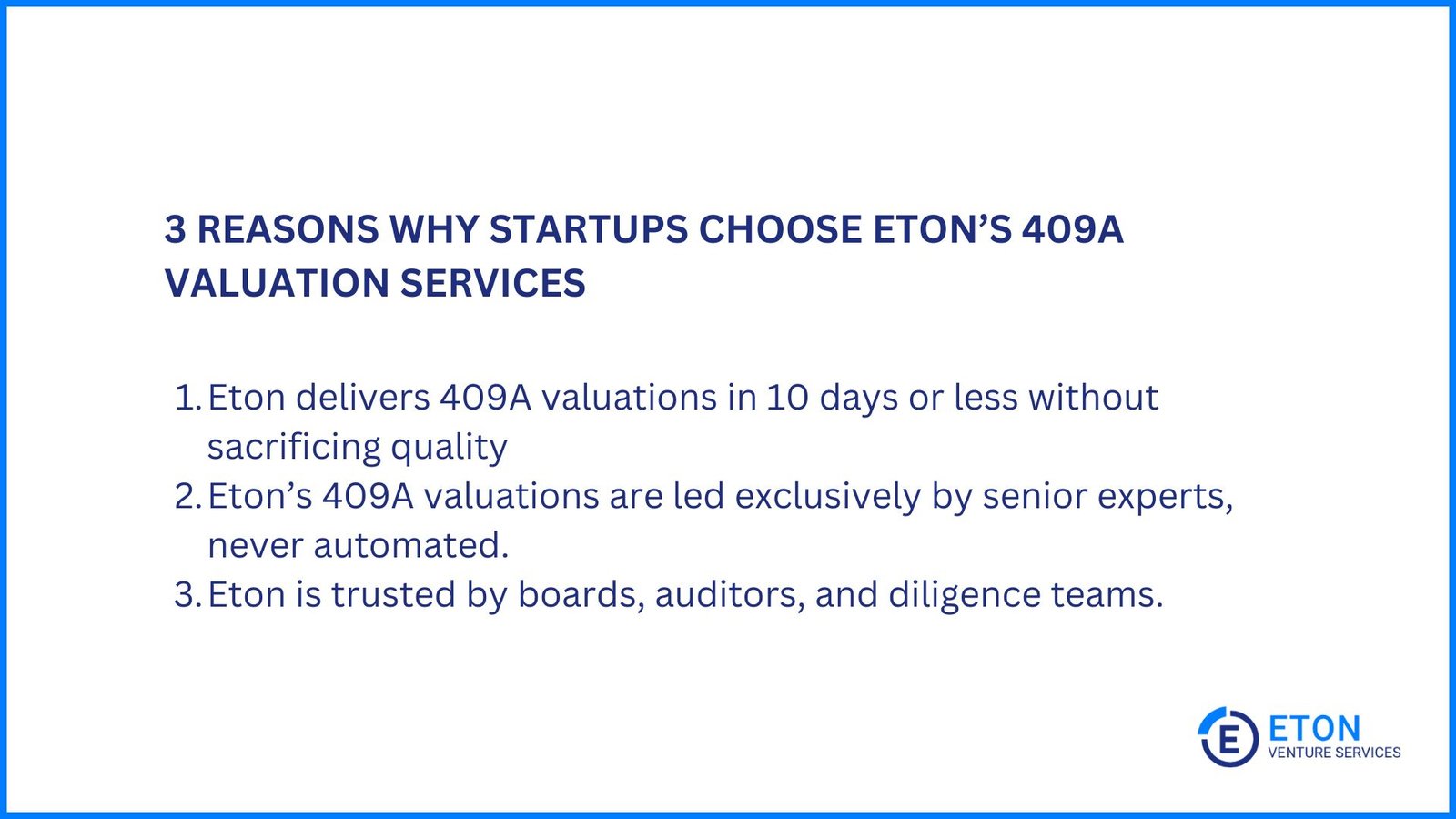
When deadlines are tight (option grants, board meetings, financing rounds), you don’t have time for trial-and-error workflows or hours spent configuring software. That’s why founders and CFOs turn to Eton for fast, audit-ready valuations that don’t require any setup on their end.
Our process removes the burden that platforms like Eqvista place on internal teams. You don’t need to import historical rounds, generate auditor snapshots, or maintain a perfectly configured cap table for the valuation to work.
We handle the data collection directly, validate every input ourselves, and deliver your 409A report in 10 business days or less. For urgent timelines, an expedited one-business-day turnaround is available.
This speed never comes at the expense of rigor. Every report is prepared to withstand board, auditor, and IRS review, backed by senior valuation professionals who have delivered more than 10,000 audit-defensible valuations with a perfect audit record.
Platforms like Eqvista rely heavily on automation and user-entered data to produce a 409A valuation. That means the system can’t interpret context, question inconsistencies, or understand whether older documents were set up correctly, all of which can materially affect fair market value. If something is missing or mis-entered, the platform has no way to catch it.
Eton’s process is intentionally human-first. Our senior valuation team, including Big-4-trained professionals, reviews source documents line by line, verifies every assumption, and applies technical judgment to areas where automated models routinely fall short.
We understand how terms interact, how risk profiles evolve, and how real-world financing dynamics should be reflected in a defensible valuation.
You don’t need to handle any platform setup or data configuration. Eton manages the full valuation preparation end-to-end and produces a report that is accurate, supportable, and aligned with IRS safe-harbor expectations.
Every valuation we deliver is built with the people who review it in mind. Boards, auditors, and due diligence teams expect clear methods, well-documented assumptions, and a logical path from inputs to the final fair market value. That structure is built into every Eton report.
We meet all formal 409A requirements, including:
Reviewers can follow the analysis without guesswork or supplemental explanations, ensuring the valuation inspires confidence from every stakeholder involved.
And when questions do arise, Eton handles them directly. Unlike platforms such as Eqvista, which do not provide audit support, we manage the technical conversations with auditors, resolve red flags, and provide the documentation needed to move reviews forward smoothly.
Here’s what one of our clients had to say about working with Eton:

For startups that prefer a single firm to handle most of their financial needs, Kruze Consulting is one of the first names I’d recommend.
Their team offers 409A valuations alongside accounting, tax, and CFO support, giving companies a broad financial toolkit under one roof.
Their valuation practice is led by former Big 4 valuation partners and investment bankers, and their reports follow AICPA and USPAP guidance.
Kruze has worked with hundreds of venture-backed companies, so they’re familiar with the cap table structures and reporting standards required for 409A compliance.
If you want your 409A handled by a firm that also handles the financial operations that support your forecasting, board updates, and investor reporting, Kruze is a strong fit. But if you prefer a valuation specialist designed for depth over breadth, a firm like Eton aligns better with that need.
Teknos stands out for one thing in particular: dual-use valuation reports that cover both IRC 409A and ASC 718 in a single engagement.
That matters if you’re heading into an audit, issuing equity, or trying to keep investor and board timelines from colliding. Instead of commissioning two analyses, you get one report built to satisfy both requirements.
Teknos work has been reviewed by Big Four auditors and the SEC, and used in IPOs, acquisitions, and other high-stakes transactions.
Much of that work sits in technology, biotech, life sciences, and AI, where equity structures are complex and assumptions don’t go unquestioned. This underscores the firm’s ability to operate in tightly reviewed environments.
They describe their dual-use process as “rapid” and “reasonably priced,” though exact fees and turnaround times aren’t publicly listed, so you’ll need to request them directly.
Aranca has been providing 409A valuations since 2005 and is well regarded for producing reports that withstand heavyweight review.
Like Teknos, their analyses have been through Big Four audit processes and SEC reviews, which gives companies confidence when preparing for high-stakes events like financings or acquisitions.
A notable differentiator is their free lifetime audit support. If auditors raise questions later, Aranca will re-engage without charging an additional fee, a valuable benefit for teams that anticipate recurring reviews.
This ongoing support is unusual for software-based providers and is more characteristic of independent valuation specialists such as Aranca and Eton, where audit defense is an essential part of delivering a 409A, not an optional add-on.
Arcana’s consultants dedicate substantial time to each valuation, often 40 hours or more, and clients interact directly with senior talent. Turnaround is generally 7-10 business days, offering a balance of speed and depth.
The main limitation is practical: Aranca operates out of India. Many companies have positive experiences, but some find that time zone gaps can drag out back-and-forth during moments when quick clarification is essential. If you expect heavy collaboration or need real-time responsiveness, that’s important to weigh as you compare providers like Eton, which operates entirely with U.S.-based senior analysts.
Stout is widely recognized for its rigorous analytical approach to 409A valuations. Their team employs advanced techniques, such as multi-scenario modeling and detailed analysis of complex equity terms, to deliver more nuanced results than basic, template-driven models typically produce.
They’re also unusually transparent for a large valuation firm. Stout regularly publishes materials explaining how they build their analyses and evaluate factors like deal structures, discount rates, and equity instruments.
For companies that value visibility into the “why” behind the number, that level of clarity can be a meaningful advantage.
As a larger firm, however, Stout’s process can feel more formal and less individualized. Startups that want direct, senior-level stewardship throughout the engagement often prefer boutique providers such as Eton, where experts stay hands-on from start to finish.
Stout does not list typical fees or turnaround timelines publicly, so you’ll need to contact them for details, helpful to note if you’re working against a board deadline or option grant schedule.
Redwood has built its reputation as a valuation-first firm and is one of the more vocal critics of automated 409A approaches. They frequently highlight how algorithmic methods can overlook important nuances, issues that may surface during auditor review.
It’s a stance echoed across human-led valuation firms, including Eton, where human judgment and context-driven analysis are central to the valuation process.
Redwood’s process reflects that belief. Instead of relying on model presets, their team reviews the company’s economics, cap-table terms, and risk considerations themselves, ensuring the final conclusion is grounded in real expertise.
A valuable feature of Redwood’s work is the inclusion of total equity or enterprise value in every report. By showing more than just the option strike price, companies and reviewers gain a clearer understanding of how the valuation fits into the broader financial picture.
Typical timelines range from 3 to 4 weeks, and more intricate cases can extend to 6 weeks. Pricing isn’t published, so interested teams will need to reach out directly.
A 409A valuation doesn’t end when the report is delivered. It lives on through option grants, audits, financings, and diligence.
And when someone asks why the number is what it is, not just the output, but the reasoning and assumptions behind it, you want a valuation that holds up.
That’s where approach matters. Software-driven valuations can be efficient, but they’re limited to what the model can capture. They don’t stress-test nuance, interpret intent in financing terms, or flag subtle inconsistencies the way an experienced appraiser will.
Human-led valuations are built around expert judgment and contextual analysis of inputs. The work isn’t just generating a number. It’s making sure the conclusion is reasonable, well-supported, and easy to defend later when the context gets scrutinized.
As you choose your next 409A valuation provider, a practical way to think about it is this: will this valuation still hold up when someone asks you to walk them through the “why”?