 Written by Chris Walton, JD
Brian Jacobs founded Akademos in 1999 to run online bookstores for colleges and universities. The idea looked defensible: Amazon had started as an online bookstore, and the education vertical was a niche the giants had largely ignored. Jacobs raised capital from friends, family, and angel investors, some of whom bought common stock at prices as high as $26 a share.
Across more than two decades, the company never turned a profit. A venture fund poured in millions through successive rounds of preferred stock and debt, each round stacking another preference onto the capital structure. By the time the fund proposed a $12.5 million cash-out merger, the common stockholders needed the company to be worth roughly $40 million before they saw a dollar. No one thought it was worth $40 million. No one thought it was worth $20 million. The best third-party offer was $10 million. The common received nothing, sued, and lost: in Jacobs v. Akademos, Inc., 326 A.3d 711 (Del. Ch. 2024), Vice Chancellor Laster found the fair value of their shares was zero. On appeal, the Delaware Supreme Court affirmed — but corrected the trial court’s reasoning along the way. Jacobs v. Akademos, Inc., 2025 WL 1924348 (Del. July 14, 2025).
The case sits at the intersection of three things that define life inside a venture-backed company — 409A valuations of common stock, preferred waterfalls that decide where value breaks, and what happens when the capital structure outgrows the enterprise it sits on. Read together, the two opinions are a practitioner’s guide to what common stock in a stacked structure is actually worth, how a Delaware court values it in an appraisal versus a fiduciary challenge, and why the answer can be nothing at all.
The facts matter because the pattern is one every venture ecosystem will recognize. Akademos began with a defensible idea, raised seed money from the founder’s network, and spent a decade chasing the scale that would make a thin-margin business pay. When the angel money ran out, it turned to venture capital. The investor was Kohlberg Ventures, LLC — the venture affiliate of Kohlberg & Company, the firm Jerome Kohlberg Jr. and his son James Kohlberg founded after leaving KKR. James Kohlberg made the 2009 investment of $2.5 million through one of his personal vehicles, Bay Area Holdings, Inc., took a board seat, and over the next decade became the company’s controlling stockholder. For simplicity, the opinion calls the investing entity the KV Fund, and so will this piece.
The Series A Preferred Stock it received carried a liquidation preference triggered by a “Deemed Liquidation Event” — a phrase that would later do real work. Then the cycle repeated. Each spring the company ran short of cash, and each time the KV Fund supplied it: more Series A in 2010, Series A-1 in 2011 (which handed the fund majority voting control), Series B in 2016 (partly by converting $3 million of debt), and then a series of promissory notes — in 2018, 2019, and 2020 — each carrying a repayment premium of 1.5x to 2x payable on a change of control.
Every infusion was necessary, documented, and offered to the common stockholders on the same terms; every time, they declined. By the merger, the KV Fund’s senior claims came to roughly $6 million in note principal, another roughly $6 million in repayment premiums, and roughly $32 million in accrued dividends and principal on the preferred — about $40 million in all. The enterprise was worth a fraction of that by every available measure.
The capital structure created a payment waterfall — a priority sequence in which each class is satisfied before the next sees anything. In a venture-backed company the order runs secured debt, then unsecured debt, then preferred by seniority, then common, with each layer absorbing enterprise value before the next is paid. At Akademos the layers were deep. The KV Notes had to be repaid with their premiums, and the preferred carried accrued dividends and a redemption right, before a dollar reached the common. On the court’s numbers, the common would not begin to participate until enterprise value approached $40 million — more than three times the $12.5 million the fund was offering.
This is the framework behind the option pricing model (OPM) and the probability-weighted expected return method (PWERM) that 409A appraisers use to allocate enterprise value across share classes. Common stock is functionally a call option: it has value only if enterprise value clears the strike — here, the stacked preferences. At $12.5 million against a roughly $40 million strike, the option is deep out of the money. In theory it still carries some value from time and volatility. In a courtroom fixing fair value on a single date, for a company with more than two decades of losses, that theoretical optionality found no factual support.
One of the company’s own directors had said as much. Burck Smith, who joined the board in 2019, refused to take his pay in options: he told the company the common would be worthless short of a deal at $41 million or more, and he doubted it could clear $20–30 million. The company declined his request for cash, and Smith settled for $25,000 and a small option grant. When a director won’t take options because he doesn’t believe the common has value, that is market evidence.
Before proposing the merger, the company and its banker, Parchman Vaughan, ran a dual-track process through the first three quarters of 2020, seeking outside investment or an acquisition. They contacted roughly 120 parties — 31 strategic buyers and 66 financial investors among them. The response was thin. No one offered to invest. On the acquisition side, the bids that came in clustered well below $10 million: a firm doing business as eCampus offered $6 million, later raised to $7 million; Ambassador Education proposed a $10.3 million deal, three-quarters of it in a two-year note; Nebraska Book floated about $17 million in enterprise value, but payable in its own illiquid stock; RedShelf and a financial buyer, Ames Watson, never got past trial balloons.
When the fund’s term sheet arrived, the banker made one more pass — sixteen additional parties, all focused on distressed assets. Three showed interest, two began diligence, none put a number on the table. A three-week go-shop after signing, during which the fund had no match rights and was bound to support any superior bid, drew nothing better.
The company’s high-water mark had come years earlier. In 2015, with gross sales past $33 million, Barnes & Noble made an unsolicited offer of roughly $30 million in stock and the parties signed a term sheet — until a major customer, City College of Chicago, signaled it might rebid its contract, Barnes & Noble cut its price to $20 million, and the talks collapsed. By 2020 the market had moved well away from even that. The $12.5 million the KV Fund offered was the most anyone would pay.
Here the case becomes genuinely instructive, because Delaware law values the same worthless common stock two different ways depending on the claim. The plaintiffs brought both: a statutory appraisal under 8 Del. C. § 262 and a plenary fiduciary-duty challenge to the squeeze-out. The two analyses run on different engines, and the difference is the most important lesson in the opinion.
The appraisal track. In an appraisal, the court must find the “fair value” of the dissenting shares as a going concern, as of the merger date, exclusive of any value arising from the merger itself. Two rules follow. First, under Cavalier Oil Corp. v. Harnett, 564 A.2d 1137 (Del. 1989), minority shares are valued at their full proportionate share of the enterprise — no minority discount, no marketability discount, no offset for the controller’s grip. Second, because the valuation excludes merger-driven value, contractual rights that fire only on a sale or liquidation drop out of the analysis.
That second rule is where the plaintiffs actually won a legal point — and it still didn’t save them. The preferred’s liquidation preference was triggered by a “Deemed Liquidation Event,” and a merger is exactly that kind of event. Under In re Appraisal of The Orchard Enterprises, Inc., 2012 WL 2923305 (Del. Ch. July 18, 2012), a preference that exists only because of the deal cannot be deducted when valuing the company as an ongoing business, so the court ignored the roughly $32 million liquidation preference for appraisal purposes. The KV Fund’s argument — that because it could veto any third-party deal, an acquirer would always have to pay the preference first — is the same argument Orchard rejected. Market reality does not override the statutory command to value the going concern on a pro rata basis.
So why was the common still worth zero? Because not every preferred right is merger-contingent. Under Shiftan v. Morgan Joseph Holdings, Inc., 57 A.3d 928 (Del. Ch. 2012), a fixed obligation the company owes regardless of any sale — a mandatory redemption right, or dividends that accrue whether or not declared — is a real feature of the going concern and must be counted. Akademos’s preferred had both: a mandatory redemption right exercisable from December 2019, and cumulative accruing dividends. Those rights let the preferred sweep up the company’s cash before the common could receive anything, and they did not depend on the merger. Valued purely as a standalone business, the company still could not satisfy them and leave anything for the common.
The going-concern numbers confirmed it. The plaintiffs’ expert reached $31.6 million with a discounted-cash-flow model, but the court rejected it: the model leaned on management’s projection of a sharp turn to profitability and on two unlaunched business lines that needed roughly $6 million the company had no way to raise. The KV Fund’s expert, valuing only the existing business, put the discounted-cash-flow value at $2.4 million. Against $6 million of note principal alone — before premiums, redemption, or accrued dividends — the common was underwater on any credible reading.
The fiduciary track. The squeeze-out analysis asks a different question. Because the KV Fund controlled the company and bought it, the transaction drew entire-fairness review, and the controller’s leverage becomes part of the picture rather than something excluded from it. Here the full stack matters: the fund could lawfully veto any deal that did not first pay off its notes and preferences, and those claims exceeded what any third party would pay. So the common’s value immediately before the merger was already zero, and receiving nothing in the merger gave the stockholders, in the court’s words, “the substantial equivalent of what they had before.” What is impermissible in an appraisal — letting the controller’s preferences and veto drive down the minority’s value — is precisely what fair price in a fairness review has to account for.
The practitioner’s point. Whether a preferred preference survives an appraisal turns on how it is drafted, not how large it is. A liquidation preference that triggers only on a sale or liquidation is a paper tiger in a § 262 proceeding; it vanishes the moment the court values the going concern. A mandatory redemption right and cumulative accruing dividends are different animals — they bind the company as it operates, and they follow it into the appraisal. For anyone structuring preferred, or advising common holders on what their stock is worth, that distinction is worth more than the headline multiple.
The plaintiffs also pointed to the company’s own 409A valuation. In September 2019 an outside firm had valued the enterprise at roughly $32 million and the common at about $8.71 a share, after a 35% discount for lack of marketability, and the board had adopted it for option grants. If the company’s own appraiser found the common had value, the plaintiffs argued, the court should credit it. Vice Chancellor Laster gave the report no weight, and his reasoning is worth reading closely if you prepare or rely on these valuations.
First, the court was skeptical of 409A valuations as a category. The firms that prepare them, he noted, generally do not charge much, and the directors who sign off are often less focused on accuracy than on how employees will feel about the number — a high common-stock value makes option grants feel meaningful. That posture, the opinion says, warrants “a heavy dose of skepticism,” echoing earlier decisions like In re Trados Inc. Shareholder Litigation, 73 A.3d 17 (Del. Ch. 2013).
Second, this particular report failed on its own terms. The defendants’ expert testified credibly that it was stale and an outlier, and that it assumed the company was a healthy going concern not in financial distress — neither of which was true by 2020. And the 35% marketability discount baked into it is the very kind of discount that Cavalier Oil forbids in an appraisal, which values the proportionate interest in the whole enterprise. A 409A report and an appraisal answer different questions: one sets an option strike price for tax compliance, the other fixes litigation fair value. They are not interchangeable, and after Akademos a litigant who leads with a 409A report should expect a court to say so.
The practical point for appraisers: your 409A conclusion is correct for its purpose. The allocation that assigns common stock a positive per-share value in a company with a stacked structure is doing valid tax-compliance work. But it is not a floor, a guarantee, or a litigation weapon. Asked “what is my common worth?”, the honest answer is that it depends on the question being asked — and on where enterprise value sits against the preferences.
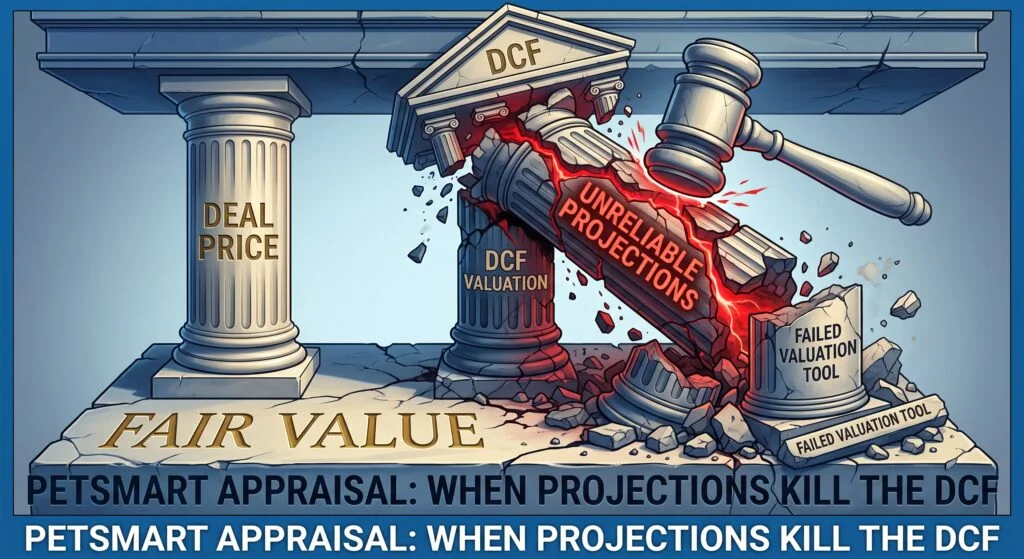
The plaintiffs’ valuation case rose and fell on its projections, and they could not bear the weight. The discounted-cash-flow model assumed a swift move from chronic losses to a double-digit EBITDA margin and counted on two new business lines — a courseware-integration product and an equitable-access offering — that had barely launched and needed roughly $6 million the company had repeatedly failed to raise. Delaware courts decline to credit projections for a business with no operating history, and they will not assume financing that the real-world record shows was unavailable. As the opinion put it, the plan represented the company’s “hoped-for reality, not its operative reality.”
The court also found the founder not credible. Jacobs had spent years insisting the company was on the cusp of success, at one point floating a $70 million valuation; the court called his assessments “Panglossian in the extreme” and observed that he was “too close to his creation to be objective.”
The lesson for founders and their counsel is not that optimism is disqualifying — it is that optimism is not evidence. A discounted-cash-flow model projecting profit for a company that has never been profitable needs a concrete, identifiable basis for the inflection: a signed contract, a launched product, a structural change in cost or revenue. “We’ll achieve scale” is not a basis. The court found nothing in the other category.
Because the merger was a conflicted-controller transaction that did not use the twin MFW protections — an independent special committee and a majority-of-the-minority vote — it drew entire-fairness review from the outset, putting the burden on the defendants to prove the deal was fair in both price and dealing. The defendants explained, persuasively to the court, that the company simply lacked the funds to run a full MFW process.
At trial, the Court of Chancery took a shortcut. Having found the common worth zero, it held that the fair-price evidence was so strong it could decide entire fairness, in its words, “without any inquiry into fair dealing.” 326 A.3d at 760. That is the move the plaintiffs attacked on appeal — and the Delaware Supreme Court agreed it went too far.
Affirming the judgment in a July 2025 order, the Court reaffirmed that entire fairness is a single, unbifurcated test: “both fair dealing and fair price must be scrutinized.” A strong price cannot excuse a court from looking at process. “Our Court has not gone so far,” the justices wrote of the trial court’s shortcut. But — and this is why the result held — price can still be, in the Court’s phrase, the “paramount consideration,” and here it was. The trial court had in fact made extensive findings about the process: that a full MFW committee was unaffordable, that the company ran a genuine dual-track market check, that the go-shop bound the controller to support any superior bid, and that the unaffiliated directors and then the full board approved the deal with the founder casting the only dissenting vote. Looking at the record as a whole, the Court was satisfied the transaction was entirely fair.
The correction matters even though the defendants won. The lesson is not that a strong price cleanses a flawed process — the Supreme Court said the opposite. It is that a controller in a distressed sale should build a defensible fair-dealing record even when the common is plainly underwater, because a reviewing court must still examine it. An open go-shop that binds the controller, a real market check, and approval by disinterested directors are affordable substitutes when a full MFW process is not.
If the protection isn’t in the courtroom — and for underwater common, after Akademos it largely isn’t — it’s in the term sheet. The capital-structure choices made at each round set the breakeven at which the common begins to participate, and, as the appraisal analysis shows, they also decide which preferences will still count if it ever comes to a fight. A few terms matter most.
Liquidation preference multiples. A 1x non-participating preference is standard; a 2x or 3x preference doubles or triples what must be returned before the common sees anything. But note the appraisal twist: a preference that triggers only on a sale or liquidation can vanish in a § 262 proceeding under Orchard. Its real bite is in a negotiated sale, where the controller’s veto gives it force.
Mandatory redemption and cumulative dividends. These are the rights that follow the company as a going concern. Under Shiftan, a fixed redemption obligation and dividends that accrue whether or not declared count in an appraisal — they are what rendered the Akademos common worthless even after the liquidation preference dropped out. For a founder, cumulative dividends are a slow ratchet: every year without a liquidity event raises the bar for the common.
Participation rights. Participating preferred takes its preference and then shares pro rata in the remainder; non-participating takes the higher of the two. Participation raises the breakeven sharply, and a participation cap limits the double-dip.
Anti-dilution. A down round triggers protection that enlarges the preferred’s share of the equity. Full ratchet is harshest; broad-based weighted average is gentler — and the gap matters most when the company is raising survival capital at a lower price.
Pay-to-play. These force existing preferred holders to join a new round or lose their preferential rights. They protect the common by stopping passive holders from free-riding on new money while keeping a full preference — a protection Akademos lacked as the KV Fund accumulated preferences round after round.
A founder who understands the waterfall — and which preferences are merger-contingent and which are not — before signing can negotiate a structure that leaves the common some daylight at exit. A founder who learns it only when the merger is proposed is the founder in Akademos.
Vice Chancellor Laster’s opinion and the Supreme Court’s affirmance are, together, a practitioner’s guide to four realities of venture-backed economics.
First, capital structure decides the valuation fight. When the preferred stack demands roughly $40 million before the common participates and the enterprise is worth $12.5 million, no method — discounted cash flow, contingent-claim model, comparable transactions — can manufacture value that isn’t there. The waterfall is the analysis.
Second, the appraisal and the squeeze-out value the same shares differently. In a § 262 appraisal, merger-contingent preferences fall away under Orchard, but fixed redemption and accruing-dividend rights count under Shiftan. In an entire-fairness review, the controller’s veto gives the whole stack force. Knowing which engine applies — and which preferred rights survive it — is the difference between a defensible valuation and a wrong one.
Third, a 409A valuation is for tax, not litigation. The court gave the company’s 409A report no weight, treating the genre with skepticism and this report as stale and built on a going-concern assumption that had failed. A 409A conclusion does not establish fair value in an appraisal or a fairness proceeding.
Fourth, entire fairness stays unitary even when the common gets zero. A strong price can predominate, but it does not let a court skip fair dealing. A controller squeezing out underwater common should still build the process record — the market check, the binding go-shop, the disinterested-director approval — because a reviewing court will look for it.
For founders, the lesson runs forward. Every preference multiple, every accruing dividend, every redemption right and repayment premium lifts the breakeven at which the common begins to participate — and the fixed ones follow the company into court. Once that breakeven passes a number no one believes the company can reach, the common is worthless, not because anyone took it, but because the structure they agreed to put it there. The courtroom can’t fix that. The term sheet can.
Chris Walton, JD, is the President & CEO of Eton Venture Services.
If you’re working through how a venture-backed company’s capital structure affects the fair value of its common stock — for a 409A engagement, a transaction, or litigation — Eton is happy to talk through the waterfall and the appraisal mechanics. The breakeven, and which preferences survive it, is usually the most important number in the work, and the one most clients have never been shown.
The tables below collect the figures and authorities behind the analysis above. All come from the two opinions in the case; dollar figures are the court’s approximations.
Priority layer | Claim ahead of common | Running total |
KV Notes — principal | ~$6 million | ~$6 million |
KV Notes — repayment premium (up to 2x) | ~$6 million | ~$12 million |
Preferred — accrued dividends + principal | ~$32 million | ~$40 million |
Common stock | participates only above ~$40 million | — |
Merger enterprise value | $12.5 million | — |
Source: Jacobs v. Akademos, Inc., 326 A.3d 711 (Del. Ch. 2024).
| Appraisal (8 Del. C. § 262) | Entire fairness (fiduciary) |
Question | Standalone fair value as a going concern, as of the merger date | Whether the price fell within a range of fairness |
Minority / marketability discount | Prohibited (Cavalier Oil) — a pro rata share of the whole | Not applied at the share level, but the controller’s leverage is part of the analysis |
Merger-contingent liquidation preference | Ignored (Orchard) — it arises from the merger | Given weight — the controller could veto any deal that did not pay it |
Fixed redemption / accruing dividends | Counted (Shiftan) — they bind the going concern | Counted |
Result for the common | Zero | Zero — the substantial equivalent of what they had before |
Sources: 326 A.3d 711 (Del. Ch. 2024); Cavalier Oil Corp. v. Harnett, 564 A.2d 1137 (Del. 1989); In re Appraisal of The Orchard Enterprises, Inc., 2012 WL 2923305 (Del. Ch. July 18, 2012); Shiftan v. Morgan Joseph Holdings, Inc., 57 A.3d 928 (Del. Ch. 2012).
When | What happened |
2009 | KV Fund invests $2.5 million for Series A Preferred; James Kohlberg joins the board |
2011 | Series A-1 investment gives the KV Fund majority voting control |
2015 | Barnes & Noble offers ~$30 million, cuts to $20 million, then terminates |
2018–2020 | KV Fund extends the 2018, 2019, and 2020 Notes, each with a repayment premium |
Feb–Sep 2020 | Dual-track process contacts ~120 parties; the best bids cluster below $10 million |
Sep 2020 | Merger closes at a $12.5 million enterprise value; the common receives nothing |
Dec 2020 | Initial closing declared void under DGCL § 251(c); the deal is restructured and re-closed |
Oct 30, 2024 | Court of Chancery: fair value of the common is $0; the transaction is entirely fair. 326 A.3d 711 |
Jul 14, 2025 | Delaware Supreme Court (en Banc) affirms; entire fairness is unitary — both prongs required. 2025 WL 1924348 |
Indicator | Value | Weight given |
Plaintiffs’ expert — discounted cash flow | $31.6 million | Rejected |
KV Fund’s expert — DCF (existing business) | $2.4 million | Credited |
KV Fund’s expert — DCF + comparables, blended | $4.3 million | — |
September 2019 409A — enterprise value | ~$32 million | No weight |
September 2019 409A — common, after 35% DLOM | ~$8.71 / share | No weight |
Merger enterprise value | $12.5 million | Deal price |
Court’s fair value of the common | $0 | Holding |
Source: Jacobs v. Akademos, Inc., 326 A.3d 711 (Del. Ch. 2024).
Schedule a free consultation meeting to discuss your valuation needs.