 Written by Chris Walton, JD
Statute, case law, methodology, and procedure — what counsel and valuation experts need to know
Delaware appraisal is its own valuation universe. The “fair value” a stockholder is entitled to under Section 262 of the Delaware General Corporation Law is neither fair market value (the IRS standard), nor fair value for financial reporting (ASC 820), nor the deal price the stockholder rejected by exercising appraisal rights. It is a statutory construct, defined by §262(h) and developed through more than seventy years of Delaware Supreme Court and Chancery decisions, that proceeds from a specific premise: the value of the target as a going concern, exclusive of any element of value arising from the merger itself. Practitioners who borrow methodology from other valuation contexts misread the regime. This guide maps the statute, the doctrine, the methodology, and the procedure for both petitioners and respondents.
Senior M&A litigators who have tried multiple appraisal proceedings in the Court of Chancery. Valuation experts who routinely testify in §262 matters. Corporate practitioners with deep institutional muscle memory on the post-DFC/Dell/Aruba framework. This is for M&A counsel who supervise but don’t directly try appraisal matters, valuation specialists encountering §262 work for the first time, and counsel for boards or stockholders weighing whether to perfect, settle, or defend an appraisal claim.
Section 262 establishes appraisal rights for stockholders of Delaware corporations that are constituents in certain merger or consolidation transactions and, per the 2022 amendments, certain conversions. Subsection (a) defines who may exercise the right: stockholders who hold continuously through the effective date, who do not vote in favor of the transaction, who comply with the written demand procedure, and (since 2022) beneficial owners who satisfy the requirements of §262(d)(3). Subsection (b) sets the categories of transactions for which appraisal is available, including the “market out” that denies appraisal for publicly traded shares except in cash-out transactions. Subsection (d) prescribes the perfection procedure: written demand before the stockholder vote, 120-day window to file the appraisal petition after the merger’s effective date.
Subsection (g), added in 2016, establishes the de minimis exception. The Court of Chancery must dismiss any appraisal proceeding concerning shares listed on a national exchange unless either the total shares seeking appraisal exceed 1% of the outstanding class, the consideration for those shares exceeds $1 million, or the merger was a short-form merger under §253 or §267. Subsection (h) — the doctrinal core — directs the Court of Chancery to determine fair value “exclusive of any element of value arising from the accomplishment or expectation of the merger or consolidation,” to take into account “all relevant factors,” and to award interest from the effective date at 5% over the Federal Reserve discount rate, compounded quarterly. The 2016 amendment to §262(h) added the corporation’s prepayment option, which stops interest from accruing on the amount prepaid.
The doctrinal architecture of fair value rests on three foundational decisions. Tri-Continental Corp. v. Battye, 74 A.2d 71 (Del. 1950), established the principle that a dissenting stockholder is entitled to “his proportionate interest in a going concern” — not a liquidation value, not the market price of the stock standing alone, but the stockholder’s pro rata share of the value of the corporation as a continuing enterprise. Weinberger v. UOP, Inc., 457 A.2d 701 (Del. 1983), abandoned the rigid “Delaware Block” valuation method that Tri-Continental had spawned (a fixed-weight average of market value, asset value, and earnings value) in favor of a more flexible standard permitting “proof of value by any techniques or methods which are generally considered acceptable in the financial community.” Weinberger also clarified that the §262(h) exclusion applies only to “speculative elements of value that may arise from the accomplishment or expectation of the merger,” not to elements of future value that are “known or susceptible of proof as of the date of the merger.”
Cavalier Oil Corp. v. Harnett, 564 A.2d 1137 (Del. 1989), completed the structure by rejecting minority and marketability discounts in §262 proceedings, holding that the appraisal remedy values the corporation as an entity and then awards the petitioner a proportionate share — not a discounted share reflecting the petitioner’s lack of control or the illiquidity of a minority position. The objective of a §262 appraisal, the court held, is “to value the corporation itself, as distinguished from a specific fraction of its shares as they may exist in the hands of a particular shareholder.” Cede & Co. v. Technicolor, Inc., 684 A.2d 289 (Del. 1996), reaffirmed that the §262(h) exclusion is a narrow one that does not displace known elements of going-concern value.
The aggregate effect: Delaware fair value is a going-concern value, computed at the corporation level, with no shareholder-level discounts, exclusive of value arising from the merger but inclusive of value that exists independent of it.
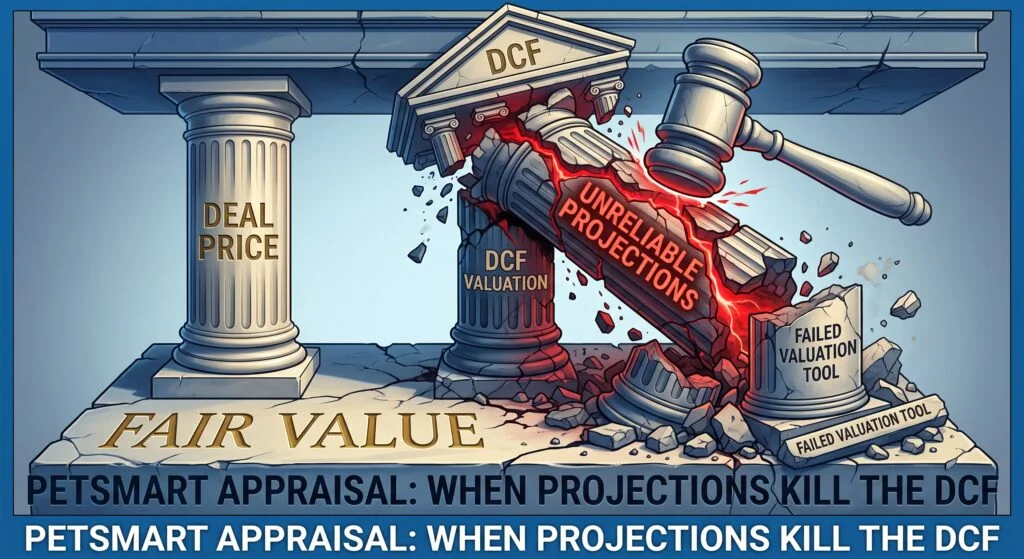
The §262(h) instruction to consider “all relevant factors” translates, in practice, to three primary valuation methodologies: deal price (with or without an adjustment for synergies), discounted cash flow, and comparable company or comparable transaction analysis. The weight given to each depends on the facts of the deal and the integrity of the sale process. For decades after Weinberger, the Court of Chancery favored discounted cash flow analysis grounded in management’s contemporaneous projections. In Golden Telecom, Inc. v. Global GT LP, 11 A.3d 214 (Del. 2010), the Delaware Supreme Court rejected any conclusive or presumptive deference to deal price, holding that the statute requires the court to take into account all relevant factors. That posture began to shift in 2017.
DFC Global Corp. v. Muirfield Value Partners, L.P., 172 A.3d 346 (Del. 2017), rejected the Court of Chancery’s blended approach (equal weight to deal price, comparable companies, and DCF) and emphasized that, where the sale process was robust, deal price is highly probative of fair value. Dell, Inc. v. Magnetar Global Event Driven Master Fund Ltd., 177 A.3d 1 (Del. 2017), reaffirmed the same point and added that deal price is persuasive in a semi-strong-form efficient market. Verition Partners Master Fund Ltd. v. Aruba Networks, Inc., 210 A.3d 128 (Del. 2019), completed the trilogy by establishing deal-price-minus-synergies as the dominant methodology when the sale process is clean, and by rejecting theoretical adjustments (most notably the “reduced agency costs” theory) that lack record support.
The framework that has emerged: where the sale process was arm’s-length, well-canvassed, and free of conflict, the Court of Chancery is likely to award fair value at deal price minus synergies. Where the process was constrained, conflicted, or involved a controlling stockholder, the court is more likely to apply DCF or a blended approach, and the appraisal award may exceed the deal price. In re Appraisal of Panera Bread Co., 2020 WL 506684 (Del. Ch. Jan. 31, 2020), is a recent example of the deal-price-minus-synergies approach in practice; In re Appraisal of Jarden Corp., 2019 WL 3244085 (Del. Ch. July 19, 2019), aff’d sub nom. Fir Tree Value Master Fund, LP v. Jarden Corp., 236 A.3d 313 (Del. 2020), is another. Unaffected market price has a more limited role — it is admissible evidence in some cases, but as Aruba clarified, it cannot substitute for deal-price-minus-synergies where deal-price evidence is available and the unaffected price predates the merger’s valuation date.
Perfection of appraisal rights is procedurally exacting; the Court of Chancery is unforgiving of foot faults. Five elements are critical.
First, the stockholder (or beneficial owner) must not vote in favor of the merger and must not consent to it in writing. Second, the stockholder must deliver a written demand for appraisal to the corporation before the stockholder vote. A proxy or vote against the merger does not satisfy this requirement; a separate written demand is required. Third, the stockholder must continuously hold the shares through the effective date of the merger. Fourth, the appraisal petition must be filed in the Court of Chancery within 120 days of the merger’s effective date. Fifth, where the appraisal is being demanded by a beneficial owner under §262(d)(3), the beneficial owner must identify the record holder, accompany the demand with documentary evidence of beneficial ownership, and include a statement affirming the documentary evidence is a true and correct copy.
The 2016 de minimis exception under §262(g) cuts off claims that once provided settlement leverage at low cost: for publicly traded shares, appraisal proceedings must be dismissed unless the shares seeking appraisal exceed 1% of the outstanding class or $1 million of merger consideration. The 2022 amendment permitting direct beneficial-owner demands eliminated the historical workaround in which beneficial owners had to chase down record holders to perfect.
The corporation’s defensive playbook has three components. First, the statutory interest exposure: from the effective date through the date of payment of judgment, interest accrues at 5% above the Federal Reserve discount rate, compounded quarterly, on the appraised value. For a long-running appraisal proceeding, the interest can become a substantial portion of the ultimate liability. The 2016 prepayment option under §262(h) is the principal tool for managing this risk: the corporation may make a cash prepayment to appraisal claimants at any time before judgment, in any amount of its choosing, to stop interest accrual on the prepaid sum. The statute does not require the claimant to refund any overpayment if the eventual appraised value is less than the prepayment — a structural risk that should be addressed contractually if the corporation chooses to make a large prepayment.
Second, the verified list: within 20 days of being served with the appraisal petition, the corporation must file a verified list of stockholders demanding appraisal with the Register in Chancery. Third, attacking perfection: the corporation may wait until after the petition is filed to raise all defects in an appraisal demand. The Court of Chancery is unforgiving of procedural lapses, and a demand that fails any element of perfection — failure to hold continuously, an inadvertent vote in favor, late filing of the petition, defective beneficial-owner documentation — will produce dismissal.
For deal teams, the post-trilogy framework has direct consequences for transaction planning.
Synergy quantification matters. The synergies the buyer expects to realize, and the methodology used to quantify them, become record evidence in any subsequent appraisal proceeding. Counsel should be aware of what their bankers and valuation advisors are documenting at signing — particularly in the fairness opinion analysis, the buyer’s internal models, and the proxy disclosure. A synergy estimate that supports a $19 appraisal award is not the same as one that supports a $25 award; the documentation that produces those estimates is created at signing, not in litigation.
Process discipline matters. A robust pre- and post-signing market check generates the deal-price reliability argument that DFC, Dell, and Aruba endorsed. A constrained process — limited bidders, no go-shop, conflicted advisors, an interested controlling stockholder — leaves the corporation without the deal-price defense and exposed to a DCF-based appraisal award.
Notice matters. The §262(d) notice to stockholders must include either a copy of the statute or a link to a publicly available electronic version, and must contain accurate disclosures sufficient for stockholders to assess whether to seek appraisal. Failure to deliver proper notice can give rise to a separate breach-of-fiduciary-duty claim against the board.
Controlling-stockholder transactions are different. In a transaction involving a controlling stockholder, the Court of Chancery applies entire fairness review unless the corporation has structured the deal to satisfy the dual-protection framework of Kahn v. M&F Worldwide Corp., 88 A.3d 635 (Del. 2014). The deal-price-as-fair-value argument is weaker in controlling-stockholder transactions, and the appraisal exposure persists even where the process is otherwise well-run.
The post-trilogy appraisal landscape is meaningfully different from the pre-2017 landscape. Appraisal arbitrage as a strategy has substantially contracted, and the population of cases where appraisal makes economic sense for petitioners has narrowed. For arm’s-length deals with clean processes, the deal-price-minus-synergies framework now functions as a de facto ceiling on appraisal exposure. The active litigation frontier has shifted to controlling-stockholder transactions, mergers with conflicted advisors or constrained sale processes, and private-company appraisals where deal-price evidence is thinner and DCF reasserts itself. Statutory interest at 5% over the Federal Reserve discount rate, even with the prepayment option, remains a meaningful cost in long-running cases.
Eton Venture Services prepares valuation analyses for Delaware appraisal proceedings, fairness opinions, and merger-related dispute valuation. Each engagement is structured to satisfy the post-DFC/Dell/Aruba framework: deal-price reliability where the sale process is clean, synergy quantification grounded in record evidence, and §262(h) fair value computed at the merger’s effective date.
Chris Walton, JD, is the President & CEO of Eton Venture Services, Ltd. Co. Contact him at cwalton@etonvs.com.
Schedule a free consultation meeting to discuss your valuation needs.