
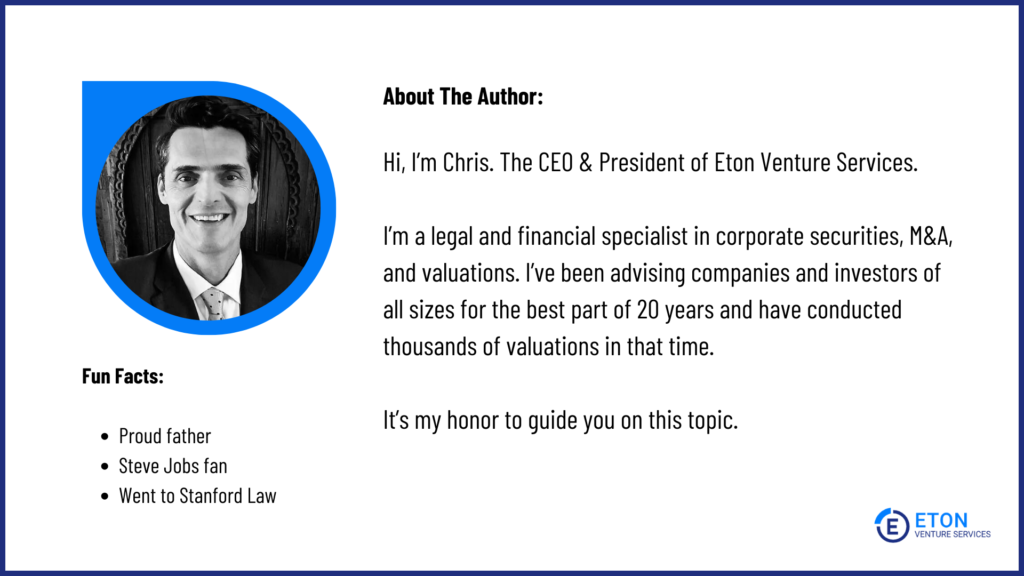
Hi, I’m Chris Walton, author of this guide and CEO of Eton Venture Services.
I’ve spent much of my career working as a corporate transactional lawyer at Gunderson Dettmer, becoming an expert in tax law & venture financing. Since starting Eton, I’ve completed thousands of business valuations for companies of all sizes.
Read my full bio here.
You’re in the middle of a transaction and need a Quality of Earnings analysis to verify the numbers, surface risks, and support your negotiating position.
Now you’re looking for a provider, but the options are confusing, and it’s not always clear who will deliver the accurate insights you need to reach a well-informed, fair deal.
This guide will help you choose with confidence. It covers what separates strong QoE providers from the rest and highlights seven reputable firms known for reliable, defensible work.
Not all quality of earnings analysis providers deliver the same level of insight or value. When evaluating firms, prioritize these four qualities:
Unlike an audit, the goal of a QoE analysis is more than confirming the numbers. It’s understanding what they mean for the deal. That’s why transaction expertise matters. Providers with M&A exposure interpret findings through a deal lens, not just an accounting one.
That’s why we recommend working with a firm who has M&A experience across different industries and deal sizes. That experience helps them:
This lets them flag issues that shape negotiations and turn financial analysis into practical, deal-ready insight before you reach the closing table.
Deals move quickly, and timing often affects outcomes. The best firms deliver within tight timelines while maintaining depth and accuracy, so you get reliable findings without slowing negotiations.
Look for providers who are transparent about pricing upfront, with clear scope and no hidden fees or surprise add-ons. The best firms offer fee structures that reflect the expertise involved and the complexity of your deal, not bloated overhead.
Some boutique firms, for example, deliver Big 4 quality without the overhead, giving you better value on engagements where cost efficiency matters.
Related Read: How Much Does a Quality of Earnings Report Cost?
Quality of Earnings analysis demands judgment, context, and experience, none of which automation can replicate.
Automated tools may process data quickly, but they often miss nuances that define true earnings quality, leading to incomplete conclusions that can cost you money at the negotiating table or create post-close disputes.
Human insight ensures every adjustment is accurate, every finding is defensible, and every conclusion is interpreted in context, reflecting the company’s real performance and what it means for the deal.
Here are seven firms that consistently meet the four qualities above, starting with our own, Eton Venture Services.
Eton Venture Services is a valuation and transaction advisory firm offering a wide range of services, including buy-side Quality of Earnings analyses for buyers and investors who need fast, defensible insights.
Our Big 4-trained team delivers the precision you’d expect from renowned, global firms, while our boutique structure ensures responsiveness and a higher level of care in every analysis.
Every engagement is treated as mission-critical, built to reveal the true story behind earnings, flag deal sensitivities early, and ensure no detail is overlooked before closing, so you can negotiate effectively and reach a fair, well-supported outcome.
Here are four reasons why clients choose Eton as their buy-side QoE analysis provider:
With thousands of Quality of Earnings analyses completed across industries, from SaaS and healthcare to manufacturing and services, Eton brings real-world experience and sector fluency to every engagement.
That track record, combined with our Big 4-level rigor, gives our team a sharper view of what truly drives earnings, helping clients surface hidden risks, validate strengths, and ultimately avoid overpaying.
Each report we produce turns complex data into clear, actionable insights that guide deal structure, debt terms, and integration priorities.
Trusted by investors, lenders, and boards, our analyses give decision-makers the clarity they need to move forward with conviction.
And because every report is built to withstand counterparty and lender review, you can count on findings that hold up under scrutiny and support fair, grounded outcomes.
When deals move fast, delays can cost negotiation power. That’s why our team keeps the process lean: efficient data requests, clear communication, and rapid coordination across management, counsel, and lenders to keep every stakeholder aligned and the deal moving.
With senior professionals overseeing every engagement, we’re able to maintain Big 4-level standards even when timelines are compressed.
We also limit the number of projects we take on at once, so your QoE analysis gets the attention it deserves. Every client is more than a company name and figures to us, which is why we’re keen to ensure each engagement gets the care it needs.
The result is a process that helps you hit key deal milestones without delay, all while ensuring your report is precise and complete, no shortcuts or missed details.
At Eton, you work directly with senior advisors who understand deal dynamics and who are hands-on from day one, with consistent check-ins, clear updates, and open lines for any questions you have in real-time.
That level of involvement keeps your analysis on track from start to finish, leaves no room for surprises, and gives you complete clarity before closing.
Our experts also walk you through key findings, ensuring you understand every adjustment and how it impacts the deal, so your decisions are always well-informed.
Every analysis is performed by experienced professionals, not automated tools or AI shortcuts.
Automation often misses context, misclassifies adjustments, or overlooks the nuances that define true financial performance. This can distort earnings quality, skew valuation outcomes, or cause buyers to overlook risks that affect deal terms. That’s why we strongly advise against it.
At Eton, every report is built from scratch to reflect the company’s structure, industry, and transaction purpose. Our experts manually review and reconcile every adjustment, ensuring each one has clear support and a sound rationale.
This human-led approach ensures findings are precise, defensible, and decision-ready, whether you’re negotiating terms, securing financing, or finalizing the deal. It also means the analysis tells the full financial story in context, so every insight supports smarter deal decisions.
Here’s what clients say about working with Eton:
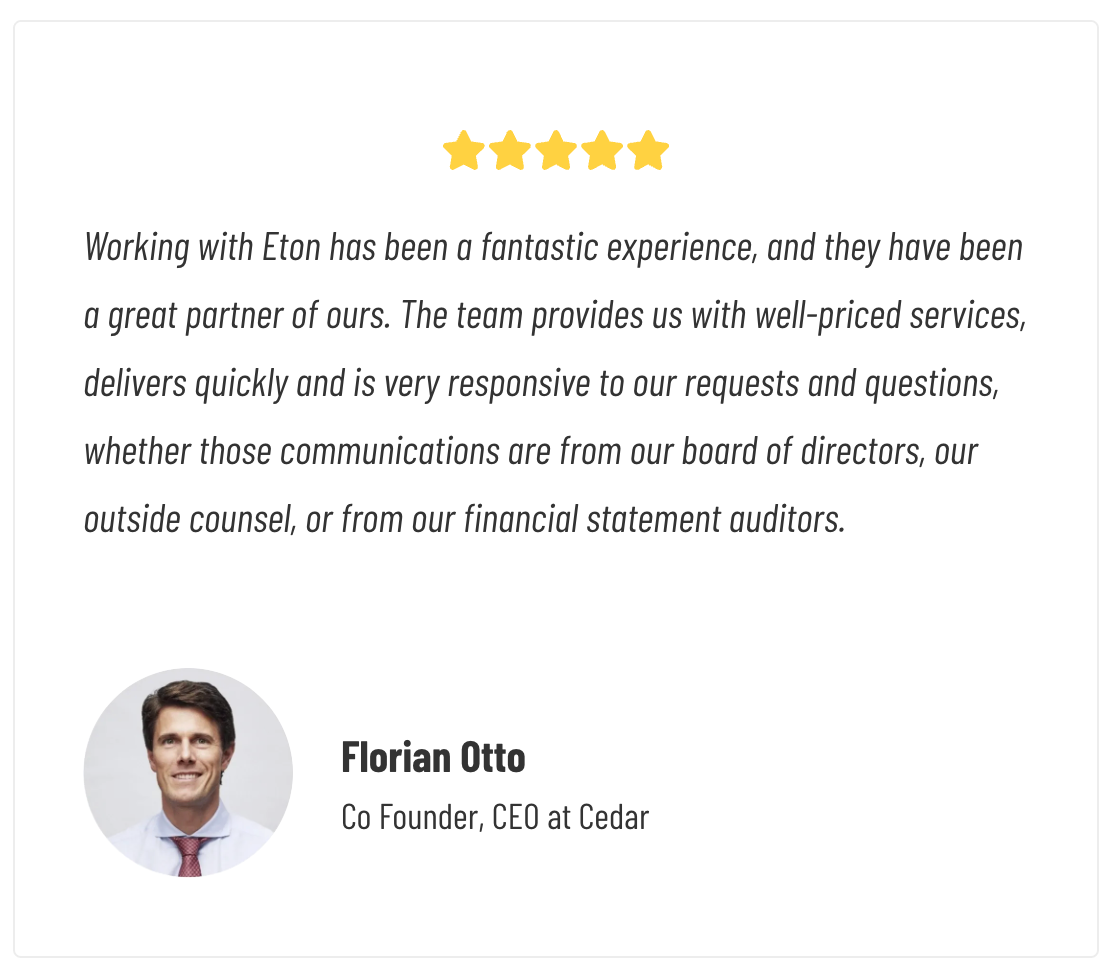
Contact us here for a free consultation.
Kroll is one of the most established names in financial and risk advisory, tracing its roots back to 1932 when it was founded as Duff & Phelps.
With more than 6,500 professionals across 32 countries, the firm brings extensive experience and global reach to its transaction and valuation services.
Its Financial Due Diligence team provides Quality of Earnings (QoE) and related analyses for buyers, sellers, lenders, and investment banks.
Kroll’s long-standing experience is reflected in its client work. In one engagement, the firm was brought in on a tight timeline to conduct a sell-side QoE for a manufacturing client whose bankers had already suggested a price.
Kroll’s team uncovered operational inefficiencies and EBITDA-enhancing opportunities that had been overlooked.
These findings led to strategic improvements that helped the client sell the business for 30% more than the initial projection, demonstrating the firm’s ability to deliver high-quality analysis that supports meaningful outcomes even under pressure.
However, while Kroll’s global presence and technical capability are clear strengths, its large scale can make the experience feel more corporate and less personal.
For companies seeking the same analytical depth with closer collaboration, a boutique firm like Eton offers a better fit, combining the same technical rigor with direct access to senior experts that allows for faster, in-depth communication, and a smoother process for business owners.
RSM is ranked as the world’s sixth-largest accounting and advisory network, known for its strong middle-market focus and broad due diligence capabilities.
The firm operates across more than 120 countries with around 65,000 professionals and completes over 1,100 deals each year, giving it substantial experience in transaction analysis, including buy-side and sell-side Quality of Earnings (QoE) engagements.
However, RSM’s network model, where independent member firms provide audit, tax, and advisory services under a shared brand, means that auditor-independence rules can limit what services they provide to certain clients.
If one RSM firm audits a company, another may be restricted from performing advisory work like QoE analysis for that same client.
In fact, the U.S. Securities and Exchange Commission (SEC) charged RSM US with violating these independence rules in 2019, leading to a $950,000 settlement and added oversight requirements.
While the firm remains a leading global player, this case illustrates the compliance complexity that large audit networks face, something independent firms like Eton avoid entirely.
Following its June 2025 merger with Moss Adams, Baker Tilly became the sixth-largest accounting and advisory firm in the United States, combining two established names in middle-market advisory.
The merger expanded the firm’s national reach and deepened its transaction expertise, positioning it as a major player for businesses seeking financial due diligence and QoE analyses.
Both firms bring long histories and extensive transaction experience; Baker Tilly tracing back to 1931 and Moss Adams to 1913.
Together, they now support thousands of transactions each year. Moss Adams alone has served more than 200 private equity firms, reflecting strong credibility within the deal community.
However, because, like RSM, they mostly serve mid-sized businesses, smaller firms may prefer a partner like Eton that offers flexible scope to also suit companies outside the middle-market profile.
Plante Moran is one of the 15 largest accounting firms in the United States and has served thousands of clients worldwide.
With more than 3,800 professionals and over a century in business, the firm has built a strong reputation for reliability in both audit and advisory work. Its reach extends beyond the U.S., with international offices in Shanghai, Mumbai, Tokyo, and Monterrey.
The firm is consistently ranked among the best accounting firms to work for, including #4 on Vault’s list right after names like PwC, Ernst & Young, and KPMG, which reflects a strong internal culture.
In environments like this, people tend to stay longer and care more, which can make a real difference in the quality of their work, including in areas like Quality of Earnings.
Plante Moran advises on more than 350 transactions each year, supporting clients through buy-side and sell-side due diligence. This scale demonstrates deep capability and well-developed internal systems.
However, it also introduces more layers in how projects are managed, so businesses seeking leaner engagements and potentially faster turnaround, backed by the same technical rigor, may find a better fit with a boutique firm like Eton.
CBIZ is one of the fastest-growing middle-market M&A consulting practices in the U.S., with more than 10,000 team members across 160 offices in 21 major markets.
The firm is widely recognized for its work in transaction advisory, providing buy- and sell-side due diligence, including Quality of Earnings analyses.
CBIZ highlights a structured yet highly responsive approach, which appeals to clients that value speed and efficiency.
Similar to Eton, its team includes many professionals with Big 4 backgrounds, giving the practice a strong technical foundation to handle complex engagements with precision.
CBIZ also distinguishes itself through a dedicated Private Equity Advisory team that supports over 400 private equity firms and 2,000 portfolio companies across North America through every stage of the deal cycle, from diligence to integration.
However, because of this strong focus on private equity transactions, its approach may not always align perfectly with the needs of owner-led businesses.
Those companies may find stronger alignment with Eton, which offers the same analytical depth, Big 4 background, and responsiveness, with an approach that adapts equally well to both investor-backed portfolios and privately held companies.
Founded in 2006, OGScapital is a financial and business consulting firm that supports small-to-mid-market transactions.
With 17 years of experience and a corporate finance team of 30 MBA consultants, the firm has worked with over 200 due diligence clients across 45+ industries.
Alongside Eton, it’s one of the smallest firms on this list compared to larger or global players, which suggests a more direct and closely managed experience for clients.
OGScapital has strong sector fluency, working across both traditional SMB industries, such as home services, HVAC, and construction, and newer digital-first sectors like e-commerce, SaaS, and mobile apps. This breadth gives the firm exposure to a wide range of business models and transaction types.
Among its notable projects, OGScapital served as the Quality of Earnings provider in NP Digital’s acquisition of SearchGuru, a cross-border transaction that expanded NP Digital’s presence in the Asia-Pacific region.
The engagement demonstrated the firm’s ability to manage complex, multi-country diligence and deliver a seamless process under international deal conditions.
Like Eton, OGScapital emphasizes responsiveness, timeliness, and cost-efficient delivery. The difference is that Eton pairs those qualities with a Big 4 background, giving clients added assurance of technical rigor and more confidence that the analysis will support stronger deal negotiations.