 Written by Chris Walton, JD
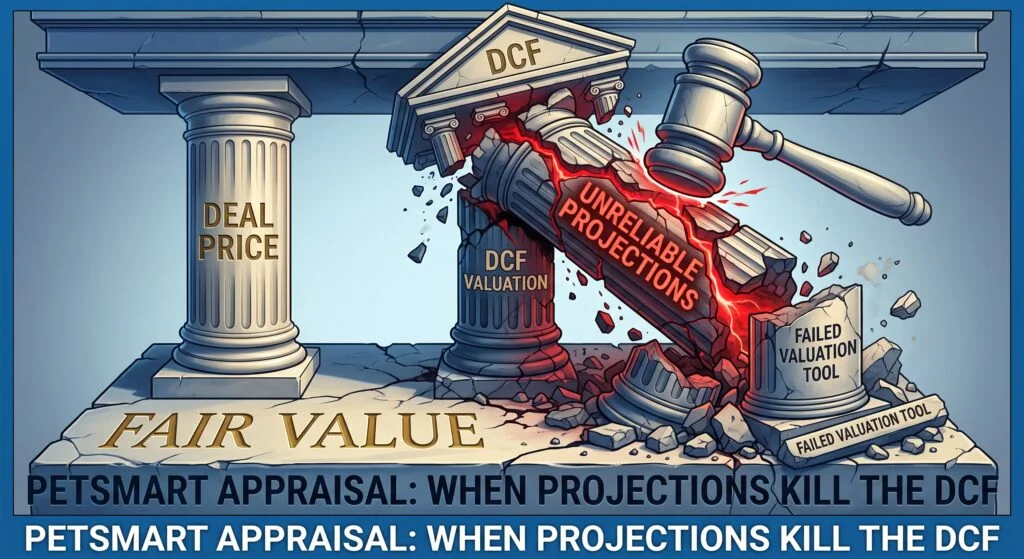
Most Delaware appraisal cases since DFC Global and Dell come down to a familiar question: is the deal price a reliable indicator of fair value? If the sale process was sound, the answer is usually yes and the court defers. If it wasn’t, the court turns to a DCF. Blueblade Capital Opportunities LLC v. Norcraft Companies, Inc., C.A. No. 11184-VCS (Del. Ch. July 27, 2018), is what happens when neither side gives the court something it can rely on. The deal price came from a flawed process. The petitioners’ expert produced a DCF at $34.78 per share. The company’s expert came in at $21.90. The spread between the two was so wide that Vice Chancellor Slights rejected both and built his own DCF from scratch.
The result — $26.16 per share, just 2.5% above the $25.50 deal price — was close enough to the merger consideration that the appraisal petitioners gained almost nothing for their effort. But the path the court took to get there is the part that matters for litigation counsel: when the sale process fails and neither expert is credible, the court doesn’t throw up its hands. It builds its own model. And when a judge is constructing a DCF from contested inputs, neither side controls the outcome.
Norcraft Companies was a cabinetry manufacturer serving the new home construction and remodeling markets. The company completed its IPO in November 2013 and was thinly traded, with limited analyst coverage. In October 2014, Fortune Brands Home & Security approached Norcraft’s CEO, Mark Buller, about an acquisition. There was no pre-signing market check. The board never tasked its financial advisor, Citi, with canvassing other potential acquirers before Fortune and Norcraft signed a merger agreement at $25.50 per share.
The board planned to rely on a post-signing go-shop to validate the price. But Vice Chancellor Slights found the go-shop was structurally ineffective: Fortune held an unlimited match right, the go-shop period was only 35 days, Fortune commenced a tender offer during that period, and tender support agreements pledging a majority of Norcraft’s stock were already in place before the go-shop concluded. None of the parties contacted made a competing bid.
The board also left the negotiations principally to Buller — who had a problem the court did not overlook. While negotiating the price, he was separately pressing Fortune for personal benefits: after failing to secure post-transaction employment, he obtained a waiver of his non-compete and a potential severance payment. The court found Buller “at least as focused on securing benefits for himself as he was on securing the best price available for Norcraft.” This was not merely a structural gap — no special committee insulated the process — but a conflicted lead negotiator, and the court found “significant flaws” in the sale process overall.
Critically, the court also declined to rely on Norcraft’s unaffected trading price as a check on fair value. The company had been public for less than two years, traded thinly in a niche market, and drew sparse analyst coverage, with a pre-IPO shareholder base still holding a majority of the shares. Without sufficient evidence that the market for Norcraft’s stock was informationally efficient, the court was unwilling to use the pre-merger trading price as a reliable indicator.
That left the court with no market-based anchor at all. Comparable companies and precedent transactions were set aside because no truly comparable companies or transactions could be identified in the cabinetry niche. The only methodology left standing was DCF — and neither side’s DCF was credible.
This is the part of Norcraft that should change how litigation counsel thinks about expert preparation. Vice Chancellor Slights didn’t adopt either expert’s model. He constructed a hybrid, selecting the inputs he found most defensible from each side and working through the disputed assumptions one at a time. The result was a model neither expert had presented and neither party had briefed.
The petitioners’ expert, David Clarke, valued Norcraft at $34.78 per share. The company’s expert, Yvette Austin Smith, concluded at $21.90 per share, relying primarily on the deal price less estimated synergies. The court rejected both, faulting each for making “choices in their analyses that were not supported by the evidence or not supported by ‘accepted financial principles’ in order to support a desired outcome.” The court then resolved the disputed inputs:
Projection period. The real disagreement was how far to project. Clarke took management’s Base Case and extended it for an additional five years, through 2024, before applying a terminal growth rate. The court refused. Norcraft operated in the classically cyclical cabinetry industry, where adjusted EBITDA had declined as recently as 2012, and the court found that Clarke’s extension implied roughly twelve years of uninterrupted growth with no cyclical correction — unreasonable for a business like this. The court declined the extension and relied on management’s unextended Base Case projections.
Terminal growth rate. Notably, this was not a disputed input. Both experts used the same 3.5% perpetuity growth rate, and the court adopted it. The terminal-value fight in Norcraft was not about the growth rate at all — it was about the length of the projection period that preceded it.
WACC inputs. Two of the court’s capital-structure choices are worth flagging because they recur in appraisal practice. First, the court used Norcraft’s actual observed debt weighting rather than a target or “optimal” capital structure, because management did not intend to change the structure. Second, in unlevering the betas of the selected comparable companies, the court held that the gross debt balance — not debt net of cash — was the correct figure.
The deal price was then used only as a “reality check.” The court’s $26.16 conclusion landed just above the $25.50 deal price — confirmation, the court said, that its DCF was grounded in reality and that the process flaws had left roughly $0.66 per share on the table, not that the deal price was itself a reliable primary indicator.
Vice Chancellor Slights used Norcraft to send a pointed message about expert partisanship. He observed that “paid valuation experts have assumed more of an advocacy role, and less of a traditional expert witness role (as illustrated by the wide deltas we regularly see in their valuation conclusions).” When the petitioners’ expert produced a value 36% above the deal price and the company’s expert produced a value 14% below it, the court treated both as advocacy documents rather than independent analyses.
The practical consequence: the court threw out both experts’ models and built its own. That’s the worst outcome for both sides — each paid for an expert whose work product was rejected, and neither party controlled the assumptions that drove the court’s conclusion. And because the court’s hybrid model wasn’t briefed by either side, neither had the opportunity to test its internal consistency through cross-examination.
For litigation counsel, the lesson is this: an expert who delivers a value conveniently close to the retaining party’s litigation position, conceding nothing to the other side, risks being treated as an advocate rather than a neutral. The expert who concedes a point or two where the opposing side’s data is stronger — and explains why those concessions don’t change the overall conclusion — is the expert the court is more likely to credit. In Norcraft, neither expert found that middle ground, and both paid for it.
Here’s a distinction Norcraft draws that practitioners should internalize: the sale process had “significant flaws” for appraisal purposes, but the court did not find a breach of fiduciary duty. Process deficiencies that fall short of a breach can still disqualify the deal price as a reliable indicator of fair value. The standards are different.
In the deal-price-deference cases — DFC Global and Dell — the Delaware Supreme Court credited the deal price because the sale process featured meaningful market checks, independent negotiation, and arm’s-length deal protections. Norcraft had none of those. The deficiencies the court identified:
No pre-signing market check. Fortune was the only bidder, and the board never had Citi canvass the market for competing interest before signing.
A conflicted lead negotiator. Buller ran the negotiations without a special committee — and was simultaneously extracting personal benefits from the buyer, which the court treated as a serious process concern.
A structurally ineffective go-shop. The 35-day go-shop was undermined by Fortune’s unlimited match right, the commencement of the tender during the go-shop period, and pre-existing tender support agreements committing a majority of the shares.
No efficient market to fall back on. Norcraft’s thin trading and short history as a public company meant the unaffected stock price couldn’t serve as a secondary check.
Any one of these deficiencies might not have been fatal. Together, they eliminated every market-based indicator the court could have used, leaving DCF as the only option.
The counterpoint to Norcraft is instructive. If the sale process included a pre-signing market check with multiple bidders, independent board negotiation (or a functioning special committee), deal protections that didn’t foreclose competition, and a go-shop that actually functioned as a price-discovery tool, the deal price will almost certainly carry the day in a Delaware appraisal. In that scenario, commissioning a competing DCF to challenge the deal price is expensive and unlikely to succeed — particularly after Dell and DFC Global established deal-price deference as the norm for sound processes.
Before retaining an expert, evaluate the sale process against the Norcraft deficiency list. If the process checks every box, the deal price is your strongest argument, and the cost of a full DCF engagement may not be justified. If one or more boxes are unchecked, the deal price may be vulnerable, and you’ll need your own model. But make sure the expert you retain is prepared to concede points where the record supports the other side. An expert whose DCF produces a value 36% above the deal price is an expert the court may reject.
Norcraft occupies a specific and important niche in Delaware appraisal law: the case where neither market evidence nor expert testimony is reliable enough to carry the day. The deal price failed because the process was flawed. Both experts failed because their valuations were perceived as partisan. The court was forced to build its own DCF — and the result ($26.16) was so close to the deal price ($25.50) that the petitioners gained almost nothing for years of litigation.
For acquirer’s counsel, the case reinforces that a sound sale process is the cheapest form of appraisal insurance. For target-side counsel and appraisal petitioners, it’s a warning: if your expert can’t find any ground to concede, the court may not find any ground to credit. And for valuation professionals, it’s a reminder that when the court builds its own model, nobody wins.
Chris Walton, JD, is President & CEO of Eton Venture Services. He can be reached at cwalton@etonvs.com.
If you’re evaluating whether to pursue or defend an appraisal claim and want a realistic assessment of whether the sale process can support deal-price deference, happy to talk through the analysis. Sometimes the process review is the case.
Blueblade Capital Opportunities LLC v. Norcraft Companies, Inc., C.A. No. 11184-VCS (Del. Ch. July 27, 2018).
DFC Global Corp. v. Muirfield Value Partners, L.P., 172 A.3d 346 (Del. 2017).
Dell, Inc. v. Magnetar Global Event Driven Master Fund Ltd., 177 A.3d 1 (Del. 2017).
Schedule a free consultation meeting to discuss your valuation needs.