
Most M&A practitioners know the 2019 appraisal headline from In re Appraisal of Columbia Pipeline Group, Inc., C.A. No. 12736-VCL (Del. Ch. Dec. 31, 2020): deal price equals fair value when the sale process is reliable. Fewer have tracked what happened next. The same judge who endorsed the $25.50 deal price later found the sale process was corrupted by conflicted officers — and awarded nearly $400 million against the buyer for aiding and abetting their breach. Then the Delaware Supreme Court reversed the buyer’s liability entirely, holding that the standard for aiding and abetting requires actual knowledge, not the constructive knowledge the trial court had applied.
Three rulings, one transaction, three different questions answered. If you’re only citing the 2019 appraisal decision, you’re missing the part that matters most for how sell-side liability actually works after Mindbody.
What Happened in the Transaction
Columbia Pipeline Group was spun off from NiSource in July 2015. Two executives — CEO Robert Skaggs and CFO Steven Smith — joined with change-in-control packages that paid roughly $25 million more if the company was sold than if it wasn’t. Both planned to retire in 2016.
Multiple acquirers expressed interest after the spinoff. What happened next, according to the Chancery Court’s factual findings, is that Skaggs and Smith steered the process toward TransCanada. Smith gave TransCanada 190 pages of confidential information the board hadn’t authorized, including advice on how to structure an offer that would avoid a competitive auction. Skaggs downplayed a competing inquiry from Spectra Energy. When the board directed them to waive standstill provisions for other bidders, they delayed over a week. Skaggs gave TransCanada a “moral commitment” that Columbia would only respond to other bids if fully financed and subject only to confirmatory diligence — a bar no other bidder could clear.
TransCanada lowered its offer from $26 to $25.50, attached a three-day deadline, and threatened to publicly announce it was walking away. The board accepted. Skaggs and Smith retired shortly after closing, collecting their change-in-control payouts.
Three Rulings, Three Different Questions
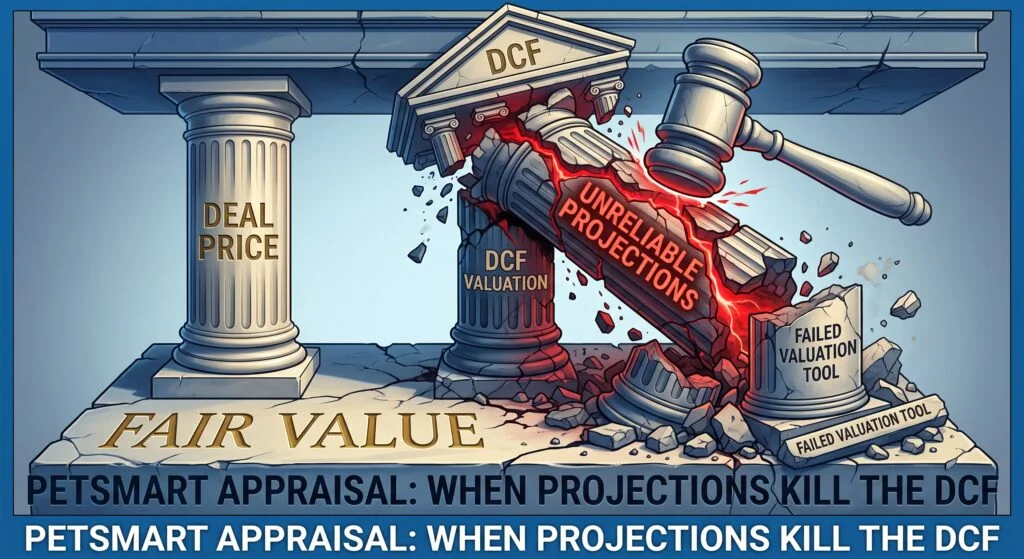
The 2019 appraisal decision asked: what was Columbia’s standalone fair value as a going concern? Vice Chancellor Laster found the deal price was the most reliable indicator. TransCanada was a “pure outsider.” The price reflected a 32% premium. The board appeared unconflicted. The petitioners’ DCF had questionable assumptions. The court called DCF a “second-best method” in these circumstances. Deal price won.
The 2023 fiduciary duty trial asked a different question: did the sale process produce the highest value reasonably available? Skaggs and Smith had already settled for a combined $79 million, so only TransCanada remained at trial. Laster found that the officers breached their duty of loyalty by prioritizing their retirement payouts, and that the board breached its duty of care by failing to manage those conflicts. He held TransCanada liable for aiding and abetting — calculating $398 million in class-wide damages ($1 per share), reduced to roughly $199 million after a DUCATA offset for the officers’ settlement.
The 2025 Supreme Court reversal asked a third question: did TransCanada actually know it was participating in a fiduciary breach? Applying the Mindbody standard issued in late 2024 — after the Chancery trial — the Supreme Court held that aiding and abetting requires actual knowledge of both the seller’s breach and the wrongfulness of the buyer’s own conduct. Constructive knowledge isn’t enough. The court found that the record didn’t support a finding that TransCanada actually knew Skaggs and Smith were breaching their duties. The $199 million judgment was reversed. Critically, TransCanada did not challenge the finding that the officers breached their duties — only its own liability for aiding and abetting that breach.
Why This Matters for Deal Price Reliance
The 2019 appraisal holding is still good law. In arm’s-length transactions with a sound sale process, deal price remains Delaware’s preferred indicator of fair value. Dell, DFC Global, Aruba, and Columbia Pipeline all say so. If you’re defending a deal price in an appraisal proceeding, those precedents haven’t moved.
But the full arc shows that appraisal fair value and fiduciary duty liability are measuring different things. The deal price can be the best available indicator of standalone going-concern value while simultaneously being less than stockholders were entitled to receive under a properly run process. Winning the appraisal doesn’t close the door to fiduciary duty claims. The two doctrines coexist.
What changed after Mindbody and the Supreme Court’s Columbia Pipeline reversal is where the liability lands. The buyer is now substantially insulated from aiding-and-abetting claims unless the plaintiff can prove the buyer had actual knowledge of both the fiduciary breach and the wrongfulness of its own participation. As Skadden noted in its analysis of the ruling, there is still no Delaware case holding an arm’s-length buyer liable for aiding and abetting sell-side fiduciary breaches. The liability sits with the officers and directors who ran the process — which is exactly where Skaggs and Smith’s $79 million settlement landed.
When You Don’t Need a Valuation Expert
The fiduciary duty case wasn’t ultimately about valuation methodology. It was about process. Before engaging a valuation expert, ask yourself whether the real issue is a valuation question or a process question:
Did management have conflicts that could have influenced the sale? Change-in-control benefits that pay out only on a sale are the classic red flag. Skaggs and Smith stood to make $25 million more from selling the company than from running it. That conflict should have been identified and managed before the sale process began.
Did management comply with the board’s directives? In Columbia Pipeline, the board told Skaggs and Smith to waive standstills for other bidders. They delayed. The board wasn’t told about Smith’s unauthorized disclosure of confidential information. When officers run a process off the rails without the board’s knowledge, the discovery record will reveal it.
Is the deal price challenge really about the number, or about the process that produced it? If management conflicts drove the outcome, a competing DCF isn’t your strongest argument. Board minutes, NDA terms, the sale process timeline, and management compensation agreements will tell you more about the strength of your case than dueling valuation models.
If the facts point to a genuine arm’s-length transaction with an unconflicted board and clean process, the deal price is likely defensible in both appraisal and fiduciary duty contexts. A competing valuation may not be worth the cost.
The Practical Takeaway After Mindbody
The simple version of Columbia Pipeline — “deal price wins in appraisal” — is accurate but incomplete. The full nine-year arc of the litigation tells a richer story: a deal price produced through a compromised process can be fair value for appraisal purposes and still generate hundreds of millions in fiduciary duty exposure. But after the Supreme Court’s reversal, that exposure lands almost entirely on sell-side fiduciaries, not on the buyer.
For target-side counsel, this sharpens the stakes. Your officers and directors bear the process risk, and the post-Mindbody scienter bar means they can’t count on sharing that liability with the buyer. Make sure management conflicts are identified before the sale begins, board directives are followed and documented in real time, competitive dynamics are preserved rather than quietly foreclosed, and the proxy accurately discloses the sale process. The $79 million Skaggs and Smith paid in settlement is real money. It came out of their pockets because the process failures were attributable to them personally.
For acquirer’s counsel, the Mindbody/Columbia Pipeline line provides substantial protection for aggressive-but-lawful negotiation. But the Supreme Court preserved the possibility of liability where a buyer “attempts to create or exploit conflicts of interest in the board” or conspires with the board in a fiduciary breach. Abide by your contractual commitments — particularly standstill agreements — and don’t cross the line from hard bargaining into exploiting known conflicts.We put together a deal-price defensibility checklist for M&A counsel — covers sale process documentation, management conflict protocols, and the common process failures that surface in fiduciary duty discovery. Happy to share it if it would be useful.