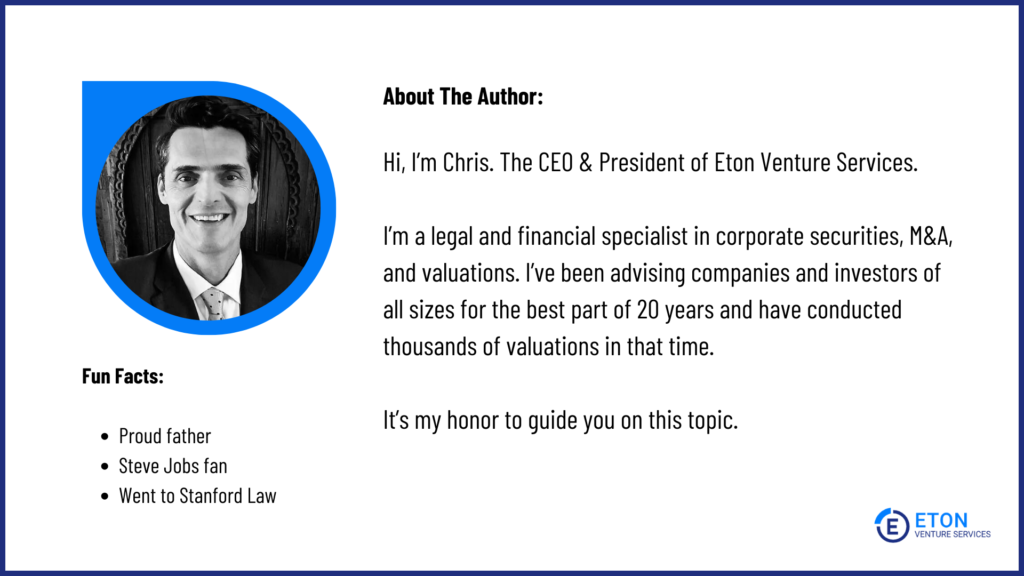
Hi, I’m Chris Walton, author of this guide and CEO of Eton Venture Services.
I’ve spent much of my career working as a corporate transactional lawyer at Gunderson Dettmer, becoming an expert in tax law & venture financing. Since starting Eton, I’ve completed thousands of business valuations for companies of all sizes.
Read my full bio here.
Choosing a due diligence firm isn’t difficult because there are no good options. It’s difficult because there are many.
There are plenty of reputable providers with experienced teams and long track records. For most deal teams, the challenge isn’t finding a firm that can do diligence but rather deciding which firms are consistently reliable and worth serious consideration.
That’s where the decision can stall. When several providers appear equally credible, it’s hard to know how to narrow the list or which differences actually matter in practice.
This article simplifies that process by shortlisting a group of the most established and reliable due diligence service providers. Each firm included is known for a specific area of strength, making it easier to choose a provider that fits the needs of your particular transaction.
We also break down how to think about selecting your next due diligence provider, so you have a clearer framework for making the decision.
Eton Venture Services occupies a distinct position in the diligence landscape: a boutique firm built specifically to deliver high-rigor financial due diligence, even when timelines are tight.
Our work is anchored in the areas with the greatest financial impact on a transaction: earnings quality, cash flow behavior, working-capital performance, and more, where precision directly shapes pricing, financing, and downside protection.
Because every engagement is led by senior due diligence experts with Big Four backgrounds and extensive deal experience, clients receive analysis that is both technically rigorous and straightforward to apply in negotiations, lender discussions, and internal decision-making.
For buyers seeking financial certainty before closing, Eton provides a level of precision and judgment that materially improves transaction outcomes.
Related Read: 7 Top Quality of Earnings (QoE) Providers
Here are the main reasons why buyers continue to choose Eton as their due diligence provider:
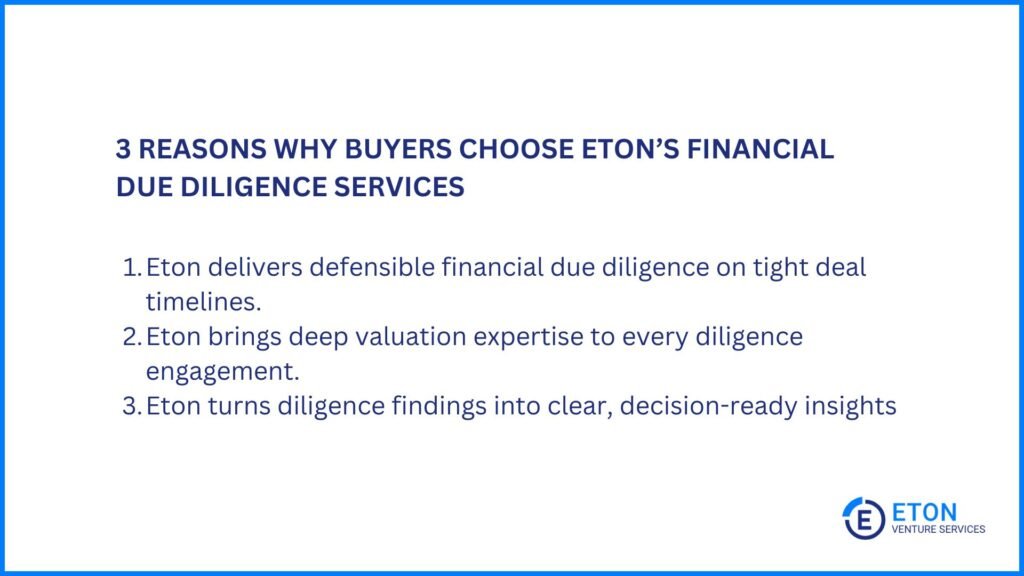
Deal teams turn to Eton when they need rapid clarity and a financial due diligence firm that moves at the pace of the deal.
Because of our boutique structure, the same experts who scope your engagement are the ones actually doing the work, avoiding the layers, delayed review cycles, and fragmented workflows common in larger firms. That ownership keeps communication tight and the analysis moving quickly.
And that speed never comes at the expense of rigor. Our financial reviews are performed line by line by senior professionals, including former Big Four consultants.
We rely on human-led, context-aware analysis rather than automated tools or templated models, allowing us to capture nuances that materially affect deal outcomes.
This approach ensures every conclusion is supported by solid evidence and defensible reasoning, giving you the grounded financial clarity needed to make confident decisions.
Having completed more than 10,000 valuations, we deeply understand what actually drives financial performance; recurring vs. non-recurring earnings, customer concentration, cost structure, cash-flow conversion, and working-capital needs.
Our valuation background means that while we’re doing diligence, we already know which findings will affect the price and how, so we focus on what actually matters for the deal economics.
With valuation experts who have worked across industries and deal types leading each project, clients receive diligence that makes the financial story clearer and easier to judge before committing capital.
Because delivering insights you can actually use is non-negotiable for us, we ensure our reports are easy to interpret so you can negotiate with confidence.
Our due diligence consultants walk you through every finding and what it means for the valuation, deal structure, and post-close performance:
Does this customer concentration justify a lower valuation? Will this working capital trend require a price adjustment? What does this cost structure mean for post-close performance?
With our senior team fully accessible throughout the engagement, you can count on quick answers and tailored guidance that keeps the work aligned with your priorities.
Here’s what clients say about working with Eton:
Alvarez & Marsal (A&M) is often the firm clients turn to when a deal is complicated, fast-moving, or high-stakes.
A large privately held advisory firm with 12,000+ professionals across 94 offices in 43 countries, they’re built for larger or more complex transactions where multiple diligence streams need to move quickly and in parallel.
Their due diligence offering spans:
Instead of treating diligence as an academic exercise, the A&M team looks at the business the way an owner or operator would: how well processes actually function, where costs hide, what integration will require, and how value could realistically be created post-close. That operator-minded lens gives deal teams a grounded view of what they’re walking into.
They’re also known for their candor. A&M’s teams don’t sugarcoat findings or dilute risks to make them more palatable. Their reports spell out issues clearly so deal teams can make informed decisions with eyes wide open.
For private equity firms, corporate acquirers, and investors facing complex situations or accelerated timelines, A&M provides a cross-functional diligence approach backed by a style that prioritizes truth, nimble action, and deal clarity.
Houlihan Lokey approaches diligence through an investment banking lens. With exposure to hundreds of transactions each year, they understand how diligence findings translate into negotiation outcomes and which risks tend to influence closing certainty.
Like Eton, the firm is a strong fit when the most important questions in a deal are financial ones: valuation drivers, earnings quality, and the metrics investors rely on to make decisions.
Apart from financial due diligence, which is their core diligence offering, they can layer in M&A tax diligence, tax structuring, and tech/cyber reviews when a deal requires additional depth.
Houlihan’s diligence team combines former Big Four accountants and sector specialists, giving their work strong industry context that helps clients understand how a target compares with peers.
However, because Houlihan Lokey operates at the scale of a global investment bank, many teams prefer a boutique financial due diligence firm like Eton, one offers the same Big Four rigor but with direct access to senior professionals and a more efficient cost structure.
FTI Consulting is a global business advisory firm with more than 8,100 professionals in 32 countries and a diligence approach built around a true 360-degree view of a business: commercial, financial, operational, IT, HR, and tax.
They are often brought into transactions where these dimensions are tightly intertwined and where deal teams want a single advisor coordinating all of them.
The firm also stands out for its ability to support execution immediately after diligence. They can assist with purchase agreements, TSA design, synergy modeling, integration planning, and even interim management, providing continuity that many firms can’t match.
For deal teams navigating multifaceted diligence requirements or preparing for a complicated post-close environment, FTI offers an integrated, senior-led approach designed to give a complete picture of both risk and readiness.
L.E.K. is best suited to transactions where the central questions relate to market and growth potential:
Their diligence work centers on commercial due diligence, drawing on deep, fact-based analysis of customers, competitors, pricing, regulation, and demand dynamics.
Through this analysis, the team evaluates revenue potential, risk exposure, margin expectations, and market scenarios to show how different conditions could affect deal value.
For private equity firms, this helps confirm whether the investment thesis is sound or whether expectations need to be recalibrated before signing.
While commercial diligence is their anchor offering, L.E.K. also supports operational and vendor due diligence.
Their operational reviews evaluate scalability, process maturity, and capital requirements, while their vendor reports help sellers present a well-supported case to buyers and avoid last-minute surprises.
As an independent global consultancy with more than 40 years of experience, you can trust L.E.K. to turn market insight into clear, defensible go/no-go guidance.
Mercer specializes in the side of due diligence that is often overlooked until it becomes a problem: the people side.
Their human capital due diligence identifies risks tied to leadership, workforce structure, compensation, culture, and compliance; issues that, in Mercer’s research, account for 60% of failed deals when left unaddressed.
Drawing on deep workforce expertise, Mercer evaluates:
Using actuarial and financial modeling, they translate these findings into cost and liability estimates that feed directly into valuation and deal structure.
Because people-related risk intersects with other diligence streams, Mercer works closely with tax, legal, and finance teams so their insights support the broader deal thesis.
Their global reach also stands out: with experts available in more than 130 countries, they can assess local labor rules and cultural dynamics quickly, often within a day.
If your deal’s value depends on leadership strength, cultural alignment, or workforce stability, Mercer delivers the insight required to understand that reality early.
Baker Tilly is a strong fit for mid-market buyers, lenders, and private equity teams that need a clear read on whether the target’s financial performance can support deal expectations.
Now the sixth-largest accounting and advisory firm in the U.S., they bring the experience to assess the elements that most directly influence deal viability.
Financial due diligence is their core. They analyze quality of earnings, working capital trends, liabilities, related-party transactions, and model assumptions to determine whether the financial story truly supports the investment thesis.
However, because the firm’s model is geared toward mid-sized businesses, smaller companies sometimes prefer a boutique firm like Eton, which offers more flexible scoping for deals outside the traditional middle-market profile.
Related Read: How Much Does a Quality of Earnings Report Cost?
In addition to financial due diligence, Baker Tilly also offers:
For mid-market clients who want diligence anchored in financial reality with support across key adjacent risk areas, Baker Tilly provides the insight required to move forward (or walk away) with confidence.
Crosslake is a technology diligence specialist built for private equity. Founded by a Microsoft Engineering Excellence team member and built around a bench of hands-on practitioners, they focus on helping investors understand the true state of a target’s engineering, infrastructure, security, and product capabilities.
Their diligence scopes flex from rapid red-flag reads to full technical assessments, with the level of detail adjusted to the pace of the deal and the complexity of the technology.
Central to their approach is TechIndicators®, a proprietary benchmarking system built from more than 4,000 technology transactions. It provides objective scoring and comparisons that help investors calibrate risk and potential value creation against real market data.
When technology is the main source of value or concern, such as with SaaS platforms, data-heavy businesses, or companies with significant security exposure, Crosslake delivers the insight needed to evaluate scalability and pinpoint where technical risk may surface post-close.
DDC focuses on a category of deal risk that traditional financial or commercial diligence rarely uncovers: the people behind the transaction.
Built around public records research experts, DDC operates purely as a due diligence consulting firm focused on investigative and investment diligence, identifying undisclosed issues tied to executives, owners, partners, and entities connected to a deal.
To uncover these risks, DDC conducts executive background checks, litigation and regulatory analysis, reputational reviews, and entity-level research across every jurisdiction where a subject has a footprint.
They emphasize source-level rigor, researching original records, verifying identities across name variations, and documenting findings that clients can rely on with legal confidence.
If you need clarity on who you’re really doing business with, DDC delivers an investigative lens that complements other diligence streams and protects against people-driven deal failure.
With several strong options to choose from, the following points can help guide your selection:
Every transaction has a different risk profile. Most deals of meaningful size will require financial, tax, and legal diligence as a foundation. These are often non-negotiable, particularly when financing is involved.
The more variable part is what else you need. In some deals, the biggest question may be market strength, for example. In others, it’s whether the technology will scale, key people will stay, or operations can integrate smoothly.
The right diligence provider is the one built to surface your primary risks early. Starting with that clarity helps you avoid overpaying for unnecessary work, or worse, missing the issues that actually move the deal.
Not all due diligence firms operate the same way behind the scenes. In some organizations, senior partners sell the engagement, but much of the analysis is delegated to junior teams with limited deal experience.
Before selecting a provider, understand who will be responsible for the core analysis, who reviews the work, and who you’ll interact with day to day.
At Eton, for example, we make sure the same senior professionals involved at the start of an engagement are also responsible for delivering the analysis, so questions are addressed by people with full context.
In fast-moving transactions, that continuity and direct access can make a real difference between timely clarity and delayed answers at critical moments.
In many transactions, diligence runs in parallel with negotiations, financing discussions, and legal work. Delays or slow turnaround can weaken leverage or force decisions to be made with incomplete information.
When evaluating due diligence providers, assess how they handle tight timelines, evolving questions, and rapid follow-ups.
Some firms are structured for extended review cycles; others, like Eton, are built to operate at deal speed without losing analytical rigor.
A firm’s ability to stay responsive under pressure often matters as much as the depth of its analysis.
Many due diligence firms are good at identifying issues. Fewer are good at explaining what those issues mean for the transaction.
Before hiring a due diligence provider, ask how their findings are framed:
Diligence that connects findings to real deal implications gives you leverage during negotiations. If your provider stops at observations, the burden of translating findings into impact falls back on the deal team.
Due diligence companies help deal teams test assumptions before capital is committed. Their job is to examine the claims, numbers, and assumptions behind a transaction and determine whether they hold up when looked at closely.
In practice, this means reviewing data, asking uncomfortable questions, and stress-testing the story being told by management or advisors.
Depending on the transaction, that work might focus on financial performance, market positioning, technology, operations, workforce dynamics, regulatory exposure, the backgrounds of key individuals connected to the deal, or span several of these areas at once.
Reliable due diligence consulting firms help buyers and sellers understand what’s normal, what’s unusual, and what requires further attention before moving forward.
The output should reduce uncertainty by separating signal from noise and clarifying which findings actually matter in the context of the transaction.
When done well, this process gives all involved parties a clearer footing going into negotiations and decision points by making risks visible and understandable.
For most transactions of meaningful size, financial, tax, and legal diligence form the baseline:
Beyond that foundation, the right scope depends on identifying what could most realistically change your view of the deal. Not every transaction carries the same sources of risk, and not every diligence stream adds equal value in every situation.
If uncertainty centers on whether the market is as attractive as believed, whether the technology will scale, whether key people are likely to stay, or whether integration risks are underestimated, you’ll layer on commercial, operational, IT, or HR diligence as appropriate.
A practical way to decide is to ask: What would cause me to renegotiate, restructure, or walk away if I learned it now?
Beyond the financial, tax, and legal baseline, the diligence you need is the diligence that answers that question clearly, before you’re too far into the process.
Strong due diligence consultants help you scope work around those decision-critical questions rather than defaulting to a standard checklist, ensuring the effort is proportional to what actually matters in your transaction.
A strong financial due diligence provider combines technical rigor with practical judgment. Beyond validating the numbers, the best firms help deal teams understand which findings matter, how they affect negotiations, and where risk truly sits.
Here are the best firms you can rely on to consistently deliver that standard:
Deal teams approach this differently depending on the transaction and their resources.
Some rely on a single provider to coordinate all diligence streams, while others center the process around a core financial provider and add specialists selectively where uncertainty or complexity is highest.
The key is matching resources to risk. Use integration when it adds efficiency without sacrificing quality. Use specialists when depth and accuracy matter more than convenience.
Schedule a free consultation meeting to discuss your valuation needs.
Chris Walton, JD, is President and CEO and co-founded Eton Venture Services in 2010 to provide mission-critical valuations to private companies. He leads a team that collaborates closely with each client’s leadership, board of directors, internal / external counsel, and independent auditors to develop detailed financial models and create accurate, audit-ready valuations.