Hi, I’m Chris Walton, author of this guide and CEO of Eton Venture Services.
I’ve spent much of my career working as a corporate transactional lawyer at Gunderson Dettmer, becoming an expert in tax law & venture financing. Since starting Eton, I’ve completed thousands of business valuations for companies of all sizes.

Read my full bio here.
Trademarks are more than just legal registrations. They’re financial assets with measurable value. So, beyond their role in legal disputes, we assign monetary value to them because they drive revenue, justify licensing fees, and play a big role in how much a brand is worth in a deal.
I’ve spent years valuing intangible assets for financial reporting, litigation, and M&A. And I’ve seen how a strong trademark signals quality and often shapes how customers choose between products. And depending on how strong that signal is, it can drive millions in sales or justify licensing fees that last for years.
To assess that value, you need more than proof of registration. What matters is how the trademark performs in the market, how well it’s protected, and what kind of business results it drives. That’s why we look at the following to arrive at a fair valuation:
Once we’ve assessed these factors, the next step is to turn that insight into a concrete number using the right valuation methods.
The rest of this article explains how these valuation methods work and when each of them makes the most sense.
Key Takeaways
|
Trademarks are intangible assets. That’s why they don’t follow the same valuation approach as physical assets like equipment or real estate. Instead, we use specialized methods to value them (you can learn more about intangible asset valuation here). These are:
If the brand is widely recognized and tied to steady revenue, you can anchor the valuation in projected income using MPEEM or in royalty savings using RRM.
But sometimes, the trademark’s direct contribution to revenue is harder to quantify. Or you might need the valuation for internal use or early-stage planning when sufficient revenue history isn’t available yet. In those cases, it may make more sense to estimate what it would cost to build a comparable trademark using the Replacement Cost Method.
The right method depends on how established the trademark is, what kind of data you have, and why you’re valuing it in the first place. Here’s how to choose between these approaches and how to apply them:

MPEEM estimates how much of a company’s income comes directly from the trademark. It starts with the company’s projected revenue, then subtracts the potential returns from all other assets. The leftover amount (called ‘excess earnings’) is how much the trademark contributes to the business’s overall value.
So, if a company expects $500,000 in total annual cash flow, and we estimate that $300,000 comes from other assets, the remaining $200,000 is linked to the trademark. That $200,000 becomes the basis for calculating what it’s worth.
MPEEM works best when the trademark is tied to a high-value, well-established brand. That’s because you can reasonably project future earnings and trace a portion of them back to the trademark itself.
Here’s exactly how it works:
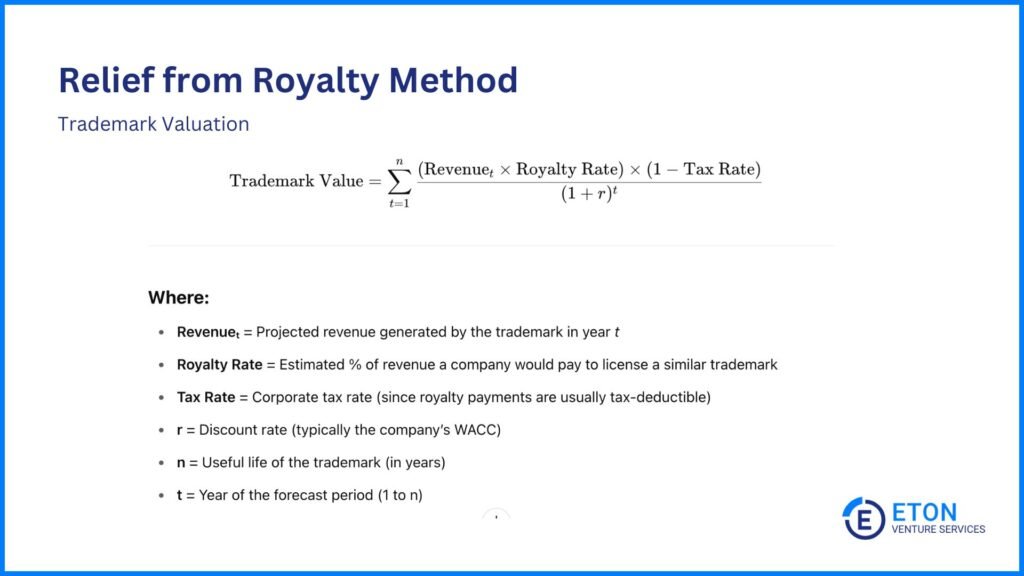
This method looks at what it would cost to license the trademark if the company didn’t already own it. When a brand name, for example, has real pulling power, it comes with a price. Many businesses pay royalties just to use a name that carries that kind of value. If you own the trademark, you avoid that cost. Those savings tell us what the trademark is worth.
Say a company sells $2 million worth of products each year under a well-known trademark. A similar brand might cost 6% of revenue to license. So by using its own trademark instead of paying for one, the company saves $120,000 a year. This amount is what we use to estimate the trademark’s value.
We apply this method when the trademark is closely tied to revenue and there’s enough data to benchmark royalty rates.
Here’s how it works step by step:
Need third-party valuation help? Explore our guide to the top healthcare valuation firms and find the right partner for your business.
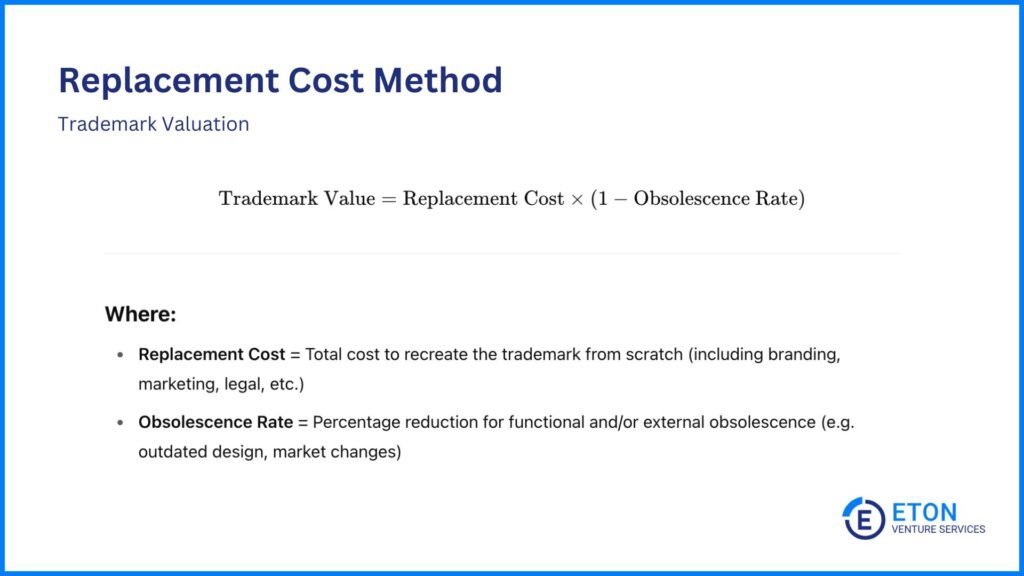
We apply the Replacement Cost Method when it’s hard to estimate how much income a trademark will generate or what it might cost to license a similar one. This often happens when the brand is early-stage, inactive, or no longer linked clearly to sales.
In cases like these, methods like MPEEM or Relief from Royalty aren’t practical, so we shift the focus from what the trademark earns to what it would cost to rebuild.
The Replacement Cost Method does that by estimating how much it would cost today to develop a new trademark that serves the same purpose. This includes creating a brand name, designing a logo, running brand campaigns, and filing for trademark protection, basically everything you’d need to launch a trademark with similar strength and recognition.
For example, if it would cost $60,000 in creative work, $100,000 in marketing and advertising, and $10,000 in legal fees to build a comparable brand, the total replacement cost would be $170,000. That gives us a rough estimate before adjusting for any loss in relevance or effectiveness.
Here’s how to apply this method in practice:
Two trademarks might both be legally protected, but one could be far more valuable because it’s widely recognized, harder to copy, or easier to license.
Factors like brand strength, exclusivity, sales volume, and global coverage all help explain that difference. They show how much impact the trademark really has and how dependable that impact is going forward.
Valuation experts play a key role in this process. We analyze these traits, highlight their impact, and make the case for how they shape the trademark’s overall value.
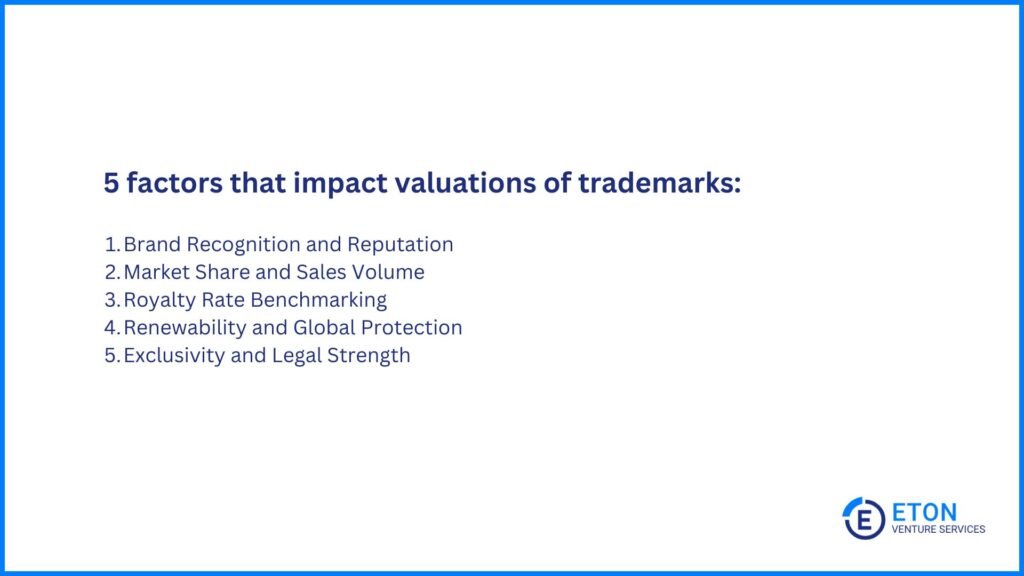
Here’s exactly what we look at:
Recognizable trademarks are often the reason someone picks one product over another, even when the products are nearly the same. This trust leads to more consistent sales and better margins. It also means businesses don’t have to fight as hard on price.
These advantages support a stronger valuation because buyers are paying for stability and avoiding the risks that come with less established or less trusted trademarks.
In valuation, you’ve got to be realistic about how much money the trademark is bringing in. It’s not always the whole company’s revenue. Some trademarks only cover one product or brand inside a bigger business. So we look at how much of the money really comes from that name.
Let’s say the company makes $10 million a year, but only $4 million comes from products sold under the trademark we’re valuing. In that case, we only factor in the $4 million.
We also look at how much of the market the trademarked product actually holds. If that $4 million comes from a best-seller in its category, the trademark is likely worth more than one tied to a product few people know, even if the numbers look the same.
Being top-of-mind with customers gives you staying power that shows up in the valuation, even if the latest numbers don’t show it yet.
This helps us figure out what someone might pay to license the trademark if they didn’t own it. To do that, we look at licensing deals for similar trademarks in the same industry.
For example, if trademarks for other snack food brands are licensed for 4-6% of revenue, and your brand fits right in that space, we’ll use that range to guide the valuation.
When a brand is stronger or better known, it often supports a higher royalty rate, usually landing closer to the top of that range. This boosts the trademark’s value.
Trademarks have time limits, but businesses can usually renew them and keep them going for years. If they’re easy to renew and already in place for the long run, it provides greater stability.
Geographic scope also matters. A trademark protected in only one country has limited value compared to one registered across key markets.
Easy renewability and broad coverage make the trademark more dependable, which typically supports a higher valuation.
A trademark only works if it’s protected. When businesses fail to defend against similar names or logos, the brand loses exclusivity and market power.
Strong trademarks have clear boundaries and defensible characteristics that make infringement cases straightforward. Weak marks, like those that are overly generic or conflict with existing brands, are more challenging to enforce. These differences in protection translate directly to differences in valuation.
At Eton Venture Services, we provide accurate, independent valuations that support your decision-making, whether you’re planning for growth, preparing for a transaction, or structuring a transition.
Our team of experts is dedicated to offering the highest level of service in assessing the value of your trademark. We ensure that all key factors, such as brand strength, sales volume, global protection and exclusivity are thoroughly considered.
Trust our experts to deliver insightful, tailored valuations that support your next move.
Yes, trademarks can be sold, either on their own or as part of a business sale. When you sell a trademark, you’re transferring all the legal rights to use that name, logo, or symbol to the buyer.
The value of what you’re selling depends on the same factors we assess in any trademark valuation: How recognizable the brand is, how much revenue it generates, how well it’s protected, and what kind of market position it holds.
One thing to keep in mind: If you sell just the trademark without the business that uses it, the buyer might face challenges building value around a name that’s no longer connected to its original products or services. That’s why trademarks often sell for more when they come with the business that built their reputation.
Personal brand trademark valuation uses the exact same methods (cost, market, and income approaches) as all trademark valuations.
The difference is that personal brands typically generate revenue through endorsements, licensing, and personal appearances rather than product sales, but we still value them using the same techniques.
Yes, trademarks can lose value over time, and it happens more often than people think. Here are some of the most common reasons why:
The reality is that trademark value isn’t static. It depends on ongoing market performance and how well you maintain legal protection. A trademark worth millions today could be worth much less tomorrow if you don’t keep it relevant and defended.
Usually no. In most business sales, the trademark value is included in the overall business valuation or goodwill.
However, you may need separate trademark valuation for things like asset sales, carve-outs, licensing deals, or when accounting standards require detailed purchase price allocation.
Schedule a free consultation meeting to discuss your valuation needs.
Chris Walton, JD, is President and CEO and co-founded Eton Venture Services in 2010 to provide mission-critical valuations to private companies. He leads a team that collaborates closely with each client’s leadership, board of directors, internal / external counsel, and independent auditors to develop detailed financial models and create accurate, audit-ready valuations.