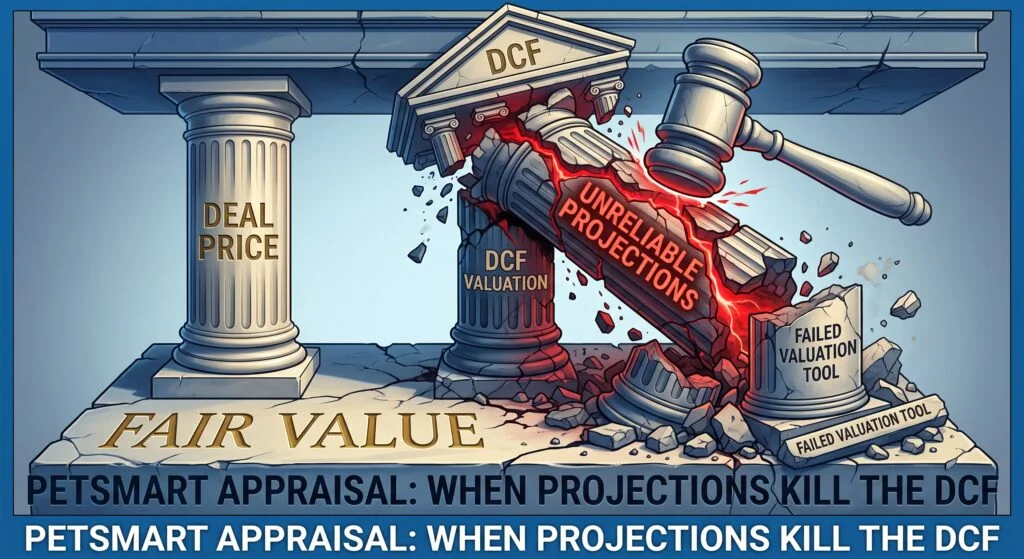

Delaware’s PetSmart appraisal ruling shows that unreliable projections don’t just weaken a DCF — they eliminate it as a primary valuation tool and leave boards largely dependent on whatever the market gave them.
When the Delaware Court of Chancery issued its appraisal decision in In re Appraisal of PetSmart, Inc., Consol. C.A. No. 10782-VCS (Del. Ch. May 26, 2017), Vice Chancellor Slights did something that should simultaneously comfort and unsettle every corporate board and financial adviser involved in a change-of-control transaction. He held that the fair value of PetSmart’s common stock equaled the merger price of $83 per share, rejecting petitioners’ expert DCF value of $128.78 per share. The court relied exclusively on the deal price as the best evidence of fair value — not because discounted cash flow analysis is disfavored in Delaware, but because the projections available in the record could not sustain a reliable DCF.
That result eliminated nearly $500 million in value that appraisal petitioners had sought. It is often characterized as a win for deal-price deference. But for boards, general counsel, and valuation professionals, the more unsettling lesson lies in why the court reached that result: PetSmart’s projection process had broken down so thoroughly that the most powerful valuation tool in the Delaware toolkit was rendered unusable. A board that cannot produce credible projections does not just risk losing a DCF argument. It loses the ability to make one at all.
The Deal, the Process, and the Appraisal
In late 2014, PetSmart agreed to be acquired in a leveraged buyout led by a BC Partners-led consortium at $83 per share in cash. The transaction followed a broad auction process: multiple financial sponsors participated, strategic interest was canvassed, the final price represented a meaningful premium to unaffected trading value, and no topping bid emerged post-signing. J.P. Morgan served as financial adviser to the PetSmart board.
After the deal closed in March 2015, a group of dissenting stockholders pursued a statutory appraisal under Section 262 of the Delaware General Corporation Law, arguing that fair value significantly exceeded the deal price. At trial, petitioners’ expert relied heavily on a DCF analysis anchored in management’s long-term projections, yielding a value of roughly $128.78 per share. The company’s expert advanced a lower DCF, closer to the merger price, and also supported reliance on the deal price itself as the best evidence of fair value.
Vice Chancellor Slights was thus presented with a familiar modern appraisal choice: adopt one expert’s DCF, blend elements of both, or give primacy to the deal price in light of an apparently sound market process. What makes PetSmart notable is the path the court chose — and why.
Why the Court Rejected DCF
Delaware courts have long described DCF as a “gold standard” valuation technique when reliable projections are available. PetSmart did not retreat from that principle. Instead, the decision underscores the other half of the sentence: without reliable projections, DCF ceases to be a trustworthy tool.
The court identified several problems with the projections in the record. The long-range forecasts were not prepared in the ordinary course of business; they were generated in connection with the sale process, at a time when PetSmart’s management had not historically produced multi-year projections with a strong track record of accuracy. The projections embedded optimistic assumptions about revenue growth and margin improvement that were not well supported by the company’s actual operating performance or competitive environment. And critically, the two sides’ DCF models — both anchored in versions of these projections — produced what the court described as a “vast delta” in indicated value, which further undermined confidence in DCF as a reliable indicator.
The court recognized that when small changes in contested assumptions — growth rates, margins, capital expenditure requirements, working-capital intensity — swing the output by billions of dollars, the underlying projections must be subjected to rigorous scrutiny. In PetSmart, that scrutiny led to one conclusion: the projections were not reliable enough to support a meaningful DCF. Once that threshold was not met, the methodology was effectively off the table as an independent basis to set fair value.
Deal Price as Fair Value
With DCF sidelined, the court turned to the one valuation indicator it did find reliable: the deal price, derived from a robust, market-tested process. PetSmart fits squarely within the Delaware trend, reinforced by the Supreme Court’s decisions in DFC Global and Dell and the Chancery Court’s contemporaneous ruling in SWS Group, in which courts look to the merger price as the best evidence of fair value when three conditions are present: a sale process featuring multiple motivated bidders; an informed board negotiating at arm’s length; and an efficient market that has digested public information and reacted to the transaction.
In PetSmart, those conditions were satisfied. The auction attracted multiple financial sponsors, strategic buyers were contacted, and the final price carried a substantial premium to unaffected trading value. No topping bid materialized, even though sophisticated private equity firms and lenders had full access to diligence materials.
Against that backdrop, and with DCF neutralized by projection weaknesses, the court concluded that the $83 per share deal price was the best and only reliable indicator of fair value. Petitioners’ $128.78 per share DCF was rejected, and appraisal arbitrageurs who had acquired shares betting on a judicial uplift left empty-handed.
Projection Governance: The Risk That Actually Materialized
But the reason DCF was sidelined — the breakdown of the projection process — contains governance lessons that deserve separate treatment.
PetSmart did not impose a judicial premium. No billions changed hands because of a court-driven DCF. But that does not make the case comforting. PetSmart shows how easily projections — the single most important input to a DCF — can become a liability when produced and deployed in a transaction setting without proper governance. A board that loses its DCF loses a critical instrument: the ability to affirmatively demonstrate that the deal price is fair, or to rebut a claim that it is not.
Develop Projections in the Ordinary Course — and Segregate Deal Overlays
Delaware courts place more weight on projections that are prepared in the ordinary course of business, created by managers with real operating responsibility, and used internally for budgeting, capital allocation, and strategic planning. Projections generated or significantly revised “for the deal” are inherently suspect. They may be shaped, consciously or not, by the incentives of executives, advisers, or buyers involved in the transaction.
In PetSmart, the long-term forecasts were prepared in connection with the sale process. That fact strongly influenced the court’s decision to sideline DCF. The lesson is practical: boards should ensure that long-range plans are developed, refreshed, and documented in the ordinary course — not cobbled together once a banker’s pitch book is already on the table.
Equally important is the separation of the operating forecast from deal-specific economics. Any transaction-driven analytical adjustments — synergies, standalone versus sponsor cost of capital, capital structure changes — should be layered on separately, clearly labeled, and never retroactively rebranded as “management projections.” The more entangled the operating forecast becomes with the deal process, the harder it is for a court to trust it as an objective basis for valuation.
Clarify Who Owns the Projections
The court’s discomfort in PetSmart was fueled in part by uncertainty over whose projections, exactly, were being relied upon. Where there is a disconnect between “management projections,” adviser-modified versions, and the numbers ultimately plugged into expert models, Delaware judges become understandably skeptical.
Projection governance demands clarity on ownership. Management should own the operating forecast. Advisers may test, challenge, and sensitize assumptions, but the final numbers used for valuation should either be clearly adopted by management — with a documented rationale — or clearly rejected, with reasons. Boards should know which set of projections they are relying on and why. When the provenance of the projections is unclear, any DCF built on them is vulnerable to exactly the kind of judicial skepticism PetSmart illustrates.
Document Every Material Adjustment
PetSmart illustrates that courts are not impressed by after-the-fact explanations. What matters is the contemporaneous record. Who proposed each material change to projections? What data or analysis supported those changes? Were the operating managers who “own” the business involved and in agreement?
Without a clear paper trail, courts may infer that changes were not grounded in robust analysis. Even if that inference is unfair, the absence of documentation makes it difficult to rebut. Every material adjustment to a forecast — especially in a transaction setting — should be accompanied by a short-written explanation that ties the change back to data, market developments, or updated strategy.
Present Multiple Scenarios and Sensitivities — Because Courts Expect Them and Practitioners Know Better
One of the striking features of modern appraisal fights is how sensitive DCF outputs are to inputs that are difficult to verify ex post. PetSmart is a textbook example: small tweaks in long-term growth rates or operating margins moved the indicated value by billions of dollars. When a court sees a single-point forecast driving a multi-billion-dollar conclusion, the natural question is: what happens if you are wrong?
It is remarkable how often this elementary discipline is absent from the record. In valuation practice — whether in a sale process, a fairness opinion, or a litigation setting — a single-case forecast should be the exception, not the rule. Yet boards routinely receive a single management case from their adviser, sometimes lightly sensitized around one or two variables but rarely stress-tested with the rigor the numbers demand. The result is a valuation conclusion that looks precise but is, in reality, brittle: change one assumption and the entire output moves by an order of magnitude.
Standard valuation practice, reflected in guidance from the AICPA, the ASA, and the CFA Institute, calls for the use of multiple scenarios when the subject company’s future cash flows are uncertain — which, in virtually every contested valuation, they are. A probability-weighted expected value model (PWERM), or a base, downside, and upside framework with transparent drivers, gives courts, boards, and counterparties a far more defensible basis for evaluating a DCF than a single-case forecast ever can.
Boards and their advisers should treat multi-scenario analysis as a governance requirement, not an analytical nicety. Require base, downside, and upside cases with clearly identified drivers. Review sensitivity tables around the discount rate, terminal growth rate, and key operating metrics. Make sure board minutes reflect the questions asked and the trade-offs considered. When a court later sees that the board engaged seriously with valuation drivers across a range of outcomes, it is more likely to view the projections — and any resulting DCF — with respect.
Establish a Track Record Before You Need One
This may be PetSmart’s most underappreciated lesson. The court’s concern was not merely that the projections were prepared in a sale context; it was that PetSmart’s management had no established history of producing reliable long-range forecasts. Without a demonstrated track record — a history of producing forecasts that can be backtested against actual results — a court has no baseline against which to evaluate whether the current projections are credible.
This is a governance challenge that cannot be solved in the heat of a transaction. Companies should build a forecasting culture in advance: produce multi-year projections annually, compare them against actuals, and document the variance analysis. When a transaction eventually arrives, the board can point to a multi-year record showing that management’s forecasts have been reasonable — or, where they have missed, that the misses were identified, analyzed, and fed back into subsequent forecasts. That body of evidence transforms projections from an untethered assertion into a credible evidentiary foundation.
Record Genuine Board Engagement
Finally, the contemporaneous record must reflect that the board did not passively receive a financial adviser’s presentation. Directors — or a special committee, if one has been constituted — should engage in substantive discussion of the projections, challenge key assumptions, and create a record through minutes, memoranda, or adviser presentations that reflects genuine deliberation. Delaware courts are increasingly sophisticated at distinguishing between boards that actually interrogated the numbers and boards that rubber-stamped an adviser’s work product.
Projection Governance Checklist
- Lock the operating plan early. Finalize long-range projections in the ordinary course, before a transaction is on the horizon.
- Clarify ownership. Require management to endorse any projections used in fairness opinions, board books, or expert reports — or explain in writing why they do not.
- Track every material change. Maintain a written log of key adjustments with supporting data or analysis.
- Demand scenarios and sensitivities. Never evaluate a single forecast in isolation; insist on ranges, stress tests, and probability-weighted frameworks.
- Segregate deal overlays. Keep transaction-specific adjustments visibly separate from the base operating forecast.
- Backtest before you need to. Build a multi-year track record of forecast-vs.-actual variance analysis.
- Record board engagement. Minutes should reflect questions asked, concerns raised, and the rationale for preferring one forecast over another.
What PetSmart Means for Boards and Valuation Professionals
PetSmart should not be misread as an anti-DCF case. Delaware courts continue to rely on discounted cash flow analysis when management projections are robust, ordinary-course, and credible. The decision is instead a warning about what happens when that foundation is missing — and the consequences are more severe than most boards appreciate.
A well-run sale process can still carry the day when projections are imperfect. In PetSmart, the court validated the deal price because the auction was competitive and the process was sound. But a sloppy projection process narrows the board’s options in ways that may not be visible until litigation. If projections are unreliable, the board may lose the ability to support its transaction with the kind of rigorous DCF that can rebut claims the price was too low — or too high. The board is left arguing that the deal price speaks for itself, with no independent analytical backstop.
For valuation professionals and litigation experts, PetSmart raises the bar on how projections must be vetted and presented in contentious settings. Experts who uncritically accept management’s sale-context projections — or who rely on heavily modified banker forecasts without a clear chain of custody — should expect searching judicial skepticism.
“The PetSmart opinion is a reminder that projection governance is not a compliance exercise — it is the foundation on which the defensibility of a transaction rests,” says Walton. “Delaware courts do not demand perfect foresight. But they do expect that when billions of dollars turn on a set of projections, those numbers are the product of a transparent, disciplined process owned by the people who actually run the business. When that process fails, the court doesn’t adjust your DCF. It throws it out.”
The Risk That Matters Most
In PetSmart, the appraisal petitioners bore the cost of the projection failure: they sought a $128.78 per share fair value and received $83. But boards should not take false comfort from that outcome. The next case may not feature a robust auction. The next projections may not be the only ones under scrutiny — the board’s own process may be. And the next court may not have a clean deal price to fall back on.
PetSmart’s deepest lesson is not about who won or lost the appraisal. It is about what it means to lose your most powerful valuation tool at the moment you need it most. For boards and valuation professionals who rely on discounted cash flow as a central methodology, that is the risk that should keep them up at night.