 Written by Chris Walton, JD
If you’ve ever watched a well-credentialed expert get taken apart on cross-examination, you know the damage usually isn’t in the conclusions. It’s in the gaps between the conclusions and the reasoning. The expert says the number is X. Opposing counsel asks why. The expert gestures at professional judgment. And the judge writes an opinion that says, in effect: show your work.
That’s what happened in DFC Global. The Delaware Supreme Court reversed the Chancery Court’s appraisal of a $1.3 billion private equity buyout — not because the trial court used the wrong valuation methods, but because it couldn’t adequately explain why it weighted them the way it did. The opinion, authored by Chief Justice Strine, identifies three specific analytical failures. Each one shows up regularly in valuation disputes. And each one is avoidable if you know what to look for.
DFC Global was a publicly traded payday lending company. By 2014, it was in trouble: heightened regulatory scrutiny in the US, UK, and Canada had hammered the stock. The company was heavily leveraged — roughly $1.1 billion in debt against $367 million in equity market cap, a 300% debt-to-equity ratio. Lone Star Funds, a private equity firm, acquired DFC for $9.50 per share after a sale process in which DFC’s financial advisor contacted 76 potential buyers. None produced a superior bid. The deal included a functioning go-shop period.
Dissenting shareholders filed for appraisal, arguing the deal price undervalued the company. Chancellor Bouchard at the Chancery Court considered three indicators of fair value: the $9.50 deal price, a comparable companies analysis at $8.07, and a DCF analysis at $13.33. He weighted all three equally, arriving at $10.30 per share — about $0.80 above the deal price. Lone Star appealed.
The Delaware Supreme Court reversed the lower court’s revised opinion. But the important part isn’t that it reversed — it’s how it reversed. The opinion doesn’t announce a new rule. It identifies three places where the trial court’s analysis broke down, and in doing so, it maps out exactly what a valuation needs to survive appellate scrutiny.
Chancellor Bouchard discounted the deal price in part because Lone Star was a financial sponsor. The reasoning: private equity firms bid based on a target internal rate of return, so the price they pay reflects their required return, not the company’s intrinsic fair value.
The Supreme Court rejected this outright. Chief Justice Strine’s language is worth knowing almost verbatim: all disciplined buyers, both strategic and financial, have internal rates of return that they expect in exchange for taking on the risk of a major investment. The fact that a buyer targets an IRR has no rational connection to whether the price it pays in a competitive process is fair.
This matters because the financial-buyer discount keeps coming up in expert reports. I’ve seen it in deposition testimony, in written opinions, and in the initial drafts of our own work when a team member hasn’t fully internalized this point. The logic sounds intuitive — of course a PE firm backs into price from a return target. But every buyer backs into price from a return target. A strategic acquirer has a cost of capital and hurdle rate too. The only difference is the capital structure used to get there, and that’s a financing choice, not a valuation deficiency.
If you see an expert report that discounts or separately weights a deal price because the buyer was a financial sponsor, flag it. After DFC Global and Dell (where the Supreme Court made the identical point four months later), that argument doesn’t survive appeal in Delaware.
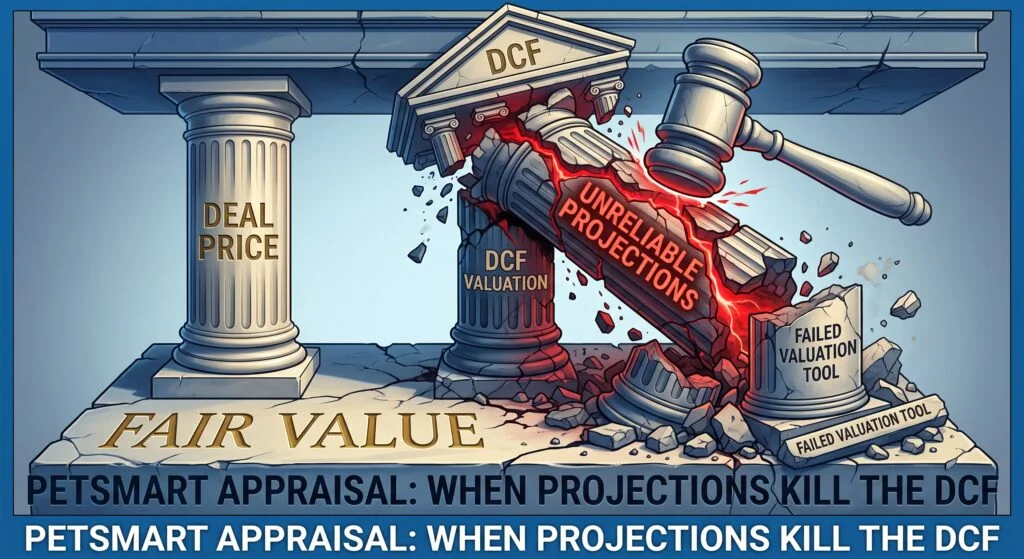
The Chancery Court’s DCF analysis produced $13.33 per share — roughly 40% above the deal price. A major driver was the perpetuity growth rate the court selected for the terminal value. The Supreme Court found that the chosen growth rate lacked adequate support in the record.
When the Supreme Court corrected the growth rate and addressed certain foreign exchange adjustments, the DCF value dropped to $7.70 per share — below the deal price. That’s a swing of $5.63 per share, driven almost entirely by a single assumption in the terminal value. On a company with roughly 39 million shares outstanding, the growth rate choice alone represented a difference of more than $200 million in implied equity value.
This is the part of the opinion that should keep valuation experts up at night. A DCF is only as defensible as its least-supported assumption, and the terminal value is where unsupported assumptions go to hide. The growth rate is small — typically 2–4% — but because it applies in perpetuity to a cash flow stream that often represents 60–80% of the total enterprise value, a half-point change can move the conclusion by billions on a large company.
The cross-examination writes itself: “Your terminal growth rate implies that this company will grow faster than the economy in perpetuity. What’s the basis for that assumption?” If the answer is professional judgment without a specific tie to the company’s competitive position, industry dynamics, or reinvestment rate, the assumption is vulnerable. After DFC Global, it’s more than vulnerable — it’s the kind of gap that gets a valuation reversed.
This is the failure that gave the case its headline. Chancellor Bouchard weighted the three valuation indicators equally — one-third to the deal price, one-third to comparable companies, one-third to the DCF — without explaining why equal weighting was appropriate. The Supreme Court called this out directly: the trial court must explain, with reference to economic facts and corporate finance principles, why it is according a certain weight to a certain indicator of value.
The problem wasn’t that equal weighting is always wrong. It’s that the court’s own factual findings undermined it. Bouchard had found that 76 potential buyers were contacted and none topped Lone Star’s bid. If the market check was that thorough, why did the deal price get the same weight as a DCF built on debatable projections and a comparable companies analysis that produced a value below the deal price? The weighting and the findings pointed in opposite directions, and nobody explained why.
For practitioners, this is the most broadly applicable lesson in the case. Every multi-method valuation involves weighting, and the temptation is to split the difference — equal weight feels neutral, feels defensible, feels like it avoids taking a strong position that can be attacked. But after DFC Global, the absence of a position is the vulnerability. If you can’t articulate in two sentences why one method got more weight than another, the weighting will not survive serious scrutiny. “Because all methods have strengths and weaknesses” is not an answer. The question is which strengths and weaknesses matter given the facts of this case.
One thing DFC Global did not do is establish a presumption that deal price equals fair value. Chief Justice Strine was explicit about that. But the opinion strongly suggests that in an arm’s-length transaction with a sound sale process, economic principles point toward the deal price as the most reliable indicator — and that departing from it requires a specific, well-supported reason.
The practical framework that has emerged from DFC Global, Dell, and their progeny looks roughly like this:
The deal price is most reliable when: the buyer is a “pure outsider” with no prior ownership stake; the sale process was competitive or included an effective market check; the board was unconflicted and advised by independent financial advisors; and there are no structural impediments (coercive deal protections, information asymmetry, management conflicts) that undermined the process. When all of those are present, it’s hard to justify giving a DCF equal or greater weight.
The DCF earns more weight when: there’s no reliable market check (freeze-outs, going-private transactions by controlling shareholders); the sale process had structural deficiencies that make the deal price less informative; or the company’s value is driven by future cash flows that the market hasn’t yet priced in. Even then, the DCF’s weight depends on the quality of its inputs — and every input needs to be tied to evidence in the record, not to professional judgment alone.
Not every appraisal dispute requires dueling DCFs. If the transaction involved an arm’s-length buyer, a contested process with a meaningful market check, an unconflicted board, and deal protections that didn’t foreclose competition, the deal price is likely your strongest evidence of fair value. In that scenario, the more productive use of your expert’s time is documenting the reliability of the sale process rather than building an alternative model.
The questions to ask before deciding whether to commission a competing valuation: Was the sale process open and competitive? Did the board have independent financial advisors? Were there meaningful price negotiations or competing bids? Are there structural reasons — conflicts, information asymmetry, deal protections — that suggest the process didn’t generate a market-clearing price? If the answers favor the process, defend the deal price and save the expense of a full DCF engagement. If one or more answers are unfavorable, the deal price may still be the right starting point, but you’ll need your own model to show what value looks like without the process deficiency.
DFC Global stands for a deceptively simple principle: explain your reasoning. Not “in my professional opinion” — that’s a conclusion, not a reason. Explain which facts in the record support the methodology you chose, the assumptions you made, and the weight you assigned. Connect the numbers to the evidence. Show that the terminal growth rate reflects something specific about this company’s reinvestment and competitive position, not a generic placeholder. Show that the weighting reflects the relative reliability of each method given the specific transaction, not an instinct to split the difference.
Chief Justice Strine’s opinion is 87 pages long, but the core message fits in a sentence: a number without reasoning is a number without credibility. That applies whether you’re defending a valuation in Delaware Chancery or presenting one in any other forum. The expert who can explain why — not just what — is the one whose opinion survives.
We put together a valuation defensibility checklist for appraisal disputes — covers methodology selection, weighting rationale, and the common assumption gaps that surface on cross-examination. Happy to share it if it would be useful.
Schedule a free consultation meeting to discuss your valuation needs.