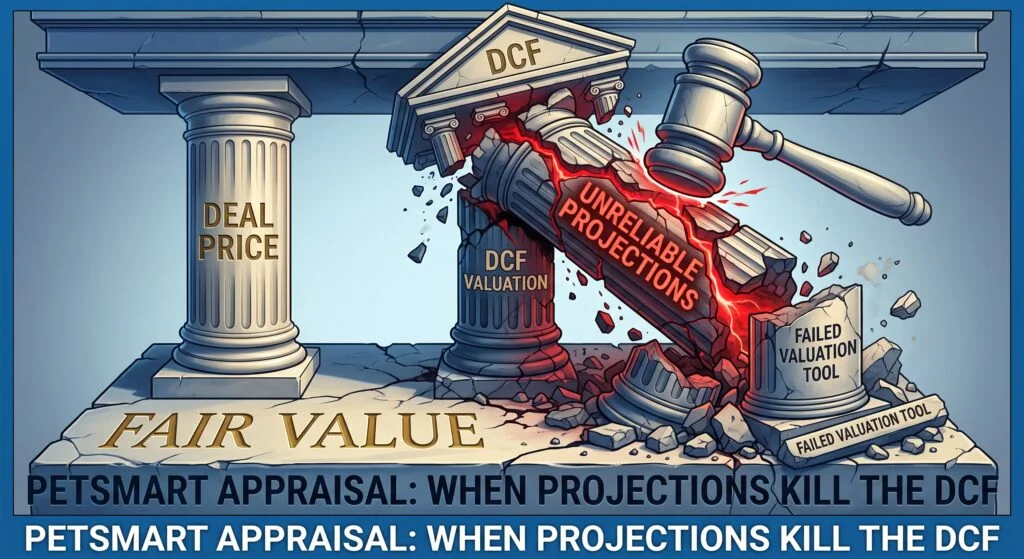

When Nobody Will Pay More, the Price Is the Value: How the Delaware Supreme Court’s Dell Appraisal Established Deal-Price Deference in Management Buyouts
Vice Chancellor Laster found that Dell Inc. was worth $17.62 per share. Michael Dell and Silver Lake Partners had paid $13.75. The difference implied that the $25 billion management buyout had undervalued the company by nearly $7 billion. The Delaware Supreme Court reversed — unanimously — and told the Chancery Court it could enter judgment at the deal price with no further proceedings.
The Supreme Court’s reasoning included a sentence that has reshaped Delaware appraisal law: “When an asset has few, or no, buyers at the price selected, that is not a sign that the asset is stronger than believed — it is a sign that it is weaker.” That sentence, from Dell, Inc. v. Magnetar Global Event Driven Master Fund Ltd. (Del. Dec. 14, 2017), is the intellectual foundation for deal-price deference in Delaware. It means that a law-trained judge performing a DCF analysis “should give pause” before “attempt[ing] to outguess all of these interested economic players with an actual stake in a company’s future.”
Together with DFC Global Corp. v. Muirfield Value Partners (Del. Aug. 1, 2017), decided four months earlier, Dell established the framework that now governs appraisal litigation in Delaware: a deal price produced by an arm’s-length process with robust market protections deserves heavy, if not dispositive, weight as evidence of fair value. The Supreme Court declined to create a formal presumption. It didn’t need to. The two decisions together make clear that the deal price will control in most cases — and that the Chancery Court’s exclusive reliance on its own DCF, at a value billions of dollars above what anyone was willing to pay, was an abuse of the discretion the appraisal statute provides.
The $25 Billion MBO That Triggered the Appraisal Wave
Dell Inc. was in transition. The company’s core PC business faced declining demand from mobile devices and cloud computing. Michael Dell, the founder, CEO, and 15.4% stockholder, had spent approximately $14 billion between 2010 and 2012 acquiring 11 businesses to pivot the company toward software and enterprise services. The market didn’t buy the turnaround story. Dell’s stock price continued to decline.
Unable to convince public investors, Michael Dell proposed a management buyout to take the company private and execute the transformation away from quarterly earnings pressure. The board formed a special committee of independent directors with full authority to evaluate the proposal and any alternatives. The committee retained financial advisors and engaged in a pre-signing process that included confidentiality agreements and due diligence with Silver Lake, KKR, TPG Capital, and Michael Dell himself.
On the advice of its financial advisor, the committee did not approach strategic buyers during the pre-signing phase, based on the assessment that strategic buyers would be uninterested in a full acquisition of Dell at the size and complexity involved. Michael Dell cooperated throughout — expressing willingness to adjust his terms, spending more time with Blackstone (a potential rival bidder) than with Silver Lake, and signing a voting agreement pledging to vote his shares in proportion to any superior proposal.
Silver Lake’s bid rose six times through the process. The final terms: $13.75 per share in cash plus a special dividend, with Michael Dell rolling over his shares at a lower per-share price. The deal represented a 37% premium over the 90-day unaffected stock price. A 45-day go-shop followed, during which the company — with a second financial advisor hired specifically for the go-shop — contacted 67 parties, including potential strategic buyers. Blackstone devoted hundreds of employees to due diligence. Carl Icahn proposed a leveraged recapitalization. HP, the most logical strategic buyer, was contacted and never entered the data room. No one submitted a superior offer. The merger was approved by stockholders, though by a narrower margin than typical for public deals.
A group of stockholders who had voted against the merger sought appraisal under Section 262 of the DGCL. They believed the stock was worth more than $13.75.
The Chancery Court’s $7 Billion Error
Vice Chancellor Laster held that the merger price undervalued Dell and that the petitioners’ assessment of fair value was too high. He performed his own DCF analysis and concluded that the fair value was $17.62 per share — 28% above the deal price. The implied additional value: nearly $7 billion.
Laster gave the deal price zero weight. His reasoning rested on three pillars, each of which the Supreme Court dismantled:
The LBO pricing model theory. The primary bidders were financial sponsors who used leveraged buyout pricing to determine their bids. An LBO model works backward from a target internal rate of return (typically 20% or more) to determine the maximum price the sponsor can pay while satisfying its investors. Laster concluded that this pricing dynamic meant the bids reflected the sponsors’ return requirements, not the company’s intrinsic value.
The valuation gap theory. Laster believed that short-sighted analysts and traders had kept Dell’s stock price artificially low because the market had not yet appreciated the company’s acquisition-driven transformation. This “investor myopia” created a “valuation gap” between the market’s assessment and the company’s true value — and that gap had anchored the deal negotiations at an artificially low starting point.
The MBO structural problems theory. Laster identified three features he considered endemic to MBOs that prevent topping bids: the ineffectiveness of go-shops (because third parties assume they can’t outbid management, who has better information), the “winner’s curse” (if management doesn’t match your bid, the company must not be worth your bid), and the perception that the buyer needs management to unlock value but management is already spoken for.
Having rejected the deal price, Laster relied exclusively on his own DCF analysis — selecting his own inputs, applying his own discount rate, and arriving at a value that no market participant, no bidder, and no analyst had endorsed.
The Supreme Court’s Reversal: Three Holdings
The Supreme Court, in a unanimous opinion by Justice Valihura, reversed on all three pillars:
The market price was reliable. The Supreme Court invoked the efficient market hypothesis — “long endorsed” by Delaware law — which holds that the price produced by an efficient market is generally a more reliable assessment of value than the findings of an expert witness in a litigation setting. Dell’s stock was actively traded, covered by dozens of analysts, had a deep public float with over 5% of shares changing hands each week, had no controlling stockholder, and had freely available information. The record showed that analysts understood Dell’s long-range plans — they simply didn’t believe the plans would work. The Chancery Court’s conclusion that the market was myopic was not supported by its own factual findings.
Financial sponsors can produce a fair price. As in DFC Global, the Supreme Court found “no rational connection between a buyer’s status as a financial sponsor and the question of whether the deal price is a fair price.” Every disciplined buyer — strategic or financial — seeks a return on investment. There is no basis to assume that strategic buyers are more generous. Moreover, 67 parties were contacted during the go-shop, including 20 potential strategic buyers. HP, the most logical strategic acquirer, declined to bid after being approached. If no strategic buyer was interested, that didn’t suggest a higher value than the deal price — it suggested a lower one.
The MBO structural problems were not present here. The Supreme Court examined the specific facts rather than applying categorical assumptions about MBOs. The go-shop was well-designed and incentivized competition (even the petitioners’ own expert conceded this). Blackstone, a sophisticated rival, devoted enormous resources to due diligence. Michael Dell cooperated with rival bidders and pledged his votes in support of any superior proposal. Between 2006 and 2015, 14 go-shops had produced superior bids, including two in MBO transactions — a “realistic pathway to success” existed for competing bidders. The information asymmetry that typically concerns courts in MBOs was mitigated by extensive due diligence and Michael Dell’s cooperation. The winner’s curse was addressed by the same evidence: Blackstone had access to everything it needed and walked away because it concluded Dell was unlikely to become profitable — not because it felt disadvantaged.
The Supreme Court remanded with discretion to enter judgment at the deal price with no further proceedings.
The Deal-Price Deference Framework: Dell and DFC Global Together
Dell and DFC Global together establish the deal-price deference framework that now governs Delaware appraisal litigation. Neither decision creates a formal presumption that the deal price equals fair value. Both decisions make clear that the deal price is entitled to heavy, if not dispositive, weight when certain conditions are met:
The transaction was negotiated at arm’s length. The sale process included a meaningful market check, either pre-signing or through a post-signing go-shop. Bidders had full access to information and few barriers to participation. No evidence suggests that a willing buyer was stifled from bidding. The deal protections (break-up fees, match rights, go-shop provisions) were reasonable and did not preclude competing offers. And — critically — no superior offer emerged despite the opportunity for one.
When these conditions are satisfied, the Supreme Court has effectively told the Chancery Court: the deal price is the best evidence of fair value, and a DCF analysis that produces a value billions of dollars above what any informed market participant was willing to pay should not be credited. The Chancery Court retains discretion to weigh all relevant factors, but that discretion does not extend to ignoring market evidence that the court’s own factual findings support.
The practical effect has been dramatic. After Dell and DFC Global, appraisal arbitrage — the practice of buying shares after a merger is announced specifically to seek a higher price in appraisal — has declined significantly. The economic thesis of appraisal arbitrage depends on the Chancery Court routinely awarding values above the deal price. When the Supreme Court makes clear that the deal price will be given heavy weight in most cases, the arbitrage strategy loses its foundation.
What Dell Means for Valuation Experts
For valuation professionals who serve as expert witnesses in appraisal proceedings, Dell changes the landscape in specific ways:
The deal price is no longer one factor among many — it’s the benchmark. Before Dell and DFC Global, a valuation expert in an appraisal case could present a DCF analysis as an independent measure of fair value with substantial weight. After these decisions, the expert’s DCF must contend with the deal price. If the expert’s value exceeds the deal price, the expert must explain why every market participant who had the opportunity to bid higher chose not to — and the explanation cannot be speculative theories about investor myopia, LBO pricing constraints, or MBO structural problems. It must be grounded in specific evidence of process failure that the Chancery Court’s factual findings support.
The DCF is most valuable when the deal price is unreliable. Dell does not eliminate the DCF. It relegates the DCF to the cases where the deal price cannot be trusted: conflicted-controller transactions without MFW protections (where the controlling stockholder is on both sides), transactions with process flaws (inadequate market check, barriers to competing bids, material information withheld from bidders), and situations where the transaction structure itself depresses the price (forced sales, distressed dispositions, thinly marketed assets). In those cases, the expert’s independent valuation fills the gap the flawed deal price creates. In an arm’s-length transaction with a robust process, the DCF is supplementary evidence, not the primary measure.
Process evidence matters as much as financial analysis. The valuation expert in a post-Dell appraisal case must understand the sale process — not just the financial statements. How many parties were contacted? How many signed NDAs? How many conducted due diligence? Were strategic buyers approached? Was there a go-shop? Did any party walk away because of process barriers, or because it concluded the company wasn’t worth more? The expert’s opinion on fair value is now evaluated against the backdrop of the market evidence the process produced. An expert who ignores that evidence and presents a DCF in a vacuum is the expert the Supreme Court criticized in Dell.
How Dell Fits the Pipeline
Dell connects to every Delaware appraisal case in the pipeline:
DFC Global (2017) was the companion case decided four months earlier. Together, they established deal-price deference. DFC Global addressed the question in the context of a financial buyer (Lone Star) acquiring a payday lending company. Dell extended the framework to management buyouts, holding that the MBO structure does not categorically undermine the deal price.
Blue Blade v. Norcraft (2018) was decided after Dell and shows what happens when the Chancery Court has no reliable deal-price evidence: Vice Chancellor Slights rejected both experts’ DCFs and built his own model from scratch. Norcraft is the post-Dell case where the process evidence didn’t support the deal price, so the Chancery Court was within its discretion to perform an independent valuation.
Stillwater Mining (2019) applied the Dell/DFC Global framework to a commodity company acquisition and adopted the deal price, finding the sale process was sufficiently robust despite the petitioners’ arguments that Sibanye’s acquisition of Stillwater was opportunistically timed during a commodity downturn.
Ramcell v. Alltel (2023) shows the blending approach: when neither the deal price nor the DCF is fully reliable, the Chancery Court can take inputs from both. Ramcell weighted the respondent’s projections at 70% and the petitioner’s at 30%, averaged discount rates, and adjusted the terminal growth rate — a more granular approach than Dell’s binary question of whether the deal price deserved weight.
Akademos (2024) is the case where the deal price produced a fair value of zero for the common stock. The deal price of $12.5 million was the highest available, but the preferred stack absorbed everything. Dell and Akademos occupy opposite ends of the deal-price spectrum: in Dell, the deal price was too low according to the Chancery Court, and the Supreme Court reversed. In Akademos, the deal price confirmed that the common had no value, and the Chancery Court agreed.
Together, these cases form a practitioner’s guide to Delaware appraisal valuation: when to defer to the deal price (Dell, DFC Global, Stillwater), when to build an independent model (Norcraft), when to blend (Ramcell), and when the deal price confirms a zero-value outcome (Akademos).
When the Deal Price Won’t Control
Dell does not hold that the deal price always controls. The Supreme Court explicitly preserved the Chancery Court’s discretion to discount the deal price when circumstances warrant. The deal price is weakest as evidence of fair value when:
The transaction involves a controlling stockholder on both sides (where the controller’s interests diverge from the minority’s). The sale process had material flaws — inadequate market check, barriers to competing bids, information asymmetry not addressed through due diligence, or deal protections that locked up the transaction before competition could develop. The price was set through a negotiation that lacked genuine competition — a single bidder with no go-shop or market check. Or there is specific evidence that a willing buyer was prevented from bidding by structural barriers the seller created.
In those cases, the Chancery Court’s independent valuation — whether a DCF, a comparable transactions analysis, or a blended approach — remains the primary tool for determining fair value. Dell restricts the Chancery Court’s ability to substitute its own valuation when the process evidence supports the deal price. It does not restrict the court when the process evidence doesn’t.
The Practical Takeaway
The Dell appraisal produced a $7 billion question: was the company worth $13.75 per share (the deal price) or $17.62 (the Chancery Court’s DCF)? The Supreme Court’s answer was the deal price — because 67 parties were contacted, the most logical strategic buyer declined, the most aggressive financial rival walked away after extensive due diligence, Michael Dell cooperated with every potential competing bidder, Silver Lake raised its bid six times, and the go-shop produced no superior offer. “When an asset has few, or no, buyers at the price selected, that is not a sign that the asset is stronger than believed — it is a sign that it is weaker.”
For M&A practitioners: the deal price is now the benchmark in Delaware appraisal. If your sale process is robust, your market check is genuine, and no superior offer emerges, the deal price will be given heavy weight. Design the process to produce the evidence the court will credit. For valuation experts: the DCF is most powerful when the deal price is unreliable. In a well-run process, the DCF supplements the deal price rather than replacing it. And for petitioners considering appraisal: Dell and DFC Global have narrowed the window for appraisal awards above the deal price. The strongest appraisal claims are now those where the process evidence reveals specific flaws — not where the petitioner’s expert constructs a DCF that produces a higher number than anyone in the market was willing to pay.
If you’re evaluating a Delaware appraisal claim or preparing a valuation for an appraisal proceeding, happy to discuss how the deal-price deference framework from Dell and DFC Global affects the analysis. The process evidence and the financial analysis must tell the same story — and after Dell, the process evidence usually wins.
Chris Walton, JD, is President & CEO of Eton Venture Services. He can be reached at cwalton@etonvs.com.